Tech
Edge Video Intelligence Solutions and Embedded Video Processing, Explained

Key Takeaways
|
What are edge video intelligence solutions, exactly?
Edge video intelligence solutions are systems that combine video analytics with edge computing, embedding intelligent video processing capability directly onto edge devices rather than routing raw footage back to a centralized server for analysis. Maris-Tech’s own definition of the category frames this clearly: a sophisticated onboard architecture enables real-time and accurate video and AI processing, such as object detection, classification, and tracking, all performed on the device itself. That distinction, processing at the source rather than after transmission, is what enables the quick response times and decision-making that surveillance and defense applications increasingly require.
What is embedded video processing, and why does it matter for compact devices?
Embedded video processing refers to integrating video processing capability directly into a hardware device, rather than relying on external computing resources to handle that workload after the fact. Maris-Tech’s own explanation of the concept highlights exactly why this matters for compact and remote platforms specifically: it allows a device to handle complex video and audio data efficiently within itself, which is particularly beneficial for devices like drones that can’t practically depend on a nearby external processor. Removing that dependency also removes a potential point of failure, since the device no longer needs a stable, continuous connection to a separate processing system just to make sense of what its own sensors are capturing.
What does a complete edge video intelligence pipeline actually involve?
Real-world edge video intelligence isn’t a single processing step; it’s a coordinated pipeline where each stage depends on the one before it functioning correctly.
| Pipeline stage | What it does |
|---|---|
| Acquisition | Captures multi-sensor video and data, spanning HD, thermal, infrared, and RF sources. |
| Processing | Compresses and encodes captured video (H.264/H.265), optimizing it under real-world bandwidth constraints. |
| AI analysis | Runs onboard analytics for object detection, classification, tracking, and behavior inference. |
| Application & distribution | Delivers situational awareness through intuitive interfaces and streams data securely over narrowband or satellite networks. |
A weak point at any single stage of this pipeline degrades the whole system’s usefulness. Excellent AI analysis is wasted if the acquisition stage delivers unstable footage, and flawless processing means little if the distribution stage can’t reliably deliver the resulting stream to the people who need it, particularly over the narrowband or contested communication links common in defense and remote operations.
How large is the market driving investment in this kind of edge processing?
Edge AI has moved from a specialized capability to a mainstream computing priority across a wide range of industries. Grand View Research’s edge AI market analysis values the global market at $24.91 billion in 2025, projected to reach $118.69 billion by 2033, a compound annual growth rate of 21.7%, driven by growing demand for real-time data processing, expanding IoT device deployment, and rising 5G-enabled applications in areas like autonomous systems and mission-critical operations. The hardware segment specifically dominates current revenue share, reflecting how much of this market’s growth still depends on physical devices capable of running AI workloads locally.
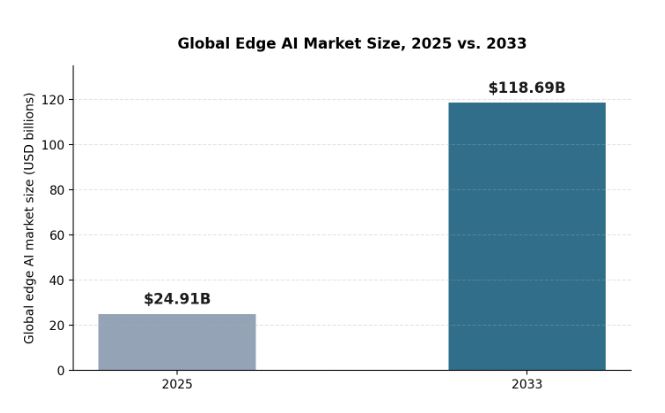

Global edge AI market size, 2025 versus 2033, according to Grand View Research.
What advantages does processing video at the edge actually deliver?
- Reduced latency: analysis happens where the data is captured, removing the round-trip delay of sending raw footage elsewhere first.
- Lower bandwidth demand: transmitting processed insights or compressed streams requires far less bandwidth than raw, unprocessed video.
- Operational resilience: a device that processes its own video keeps functioning usefully even if its connection to a remote system is degraded or lost.
- Faster decision-making: real-time object detection and tracking at the source shortens the time between an event occurring and a response being possible.
Where do these capabilities get applied in practice?
Edge video intelligence solutions and embedded video processing aren’t confined to a single industry. They support intelligent video surveillance with object recognition and behavior analysis for actionable intelligence, and they extend into defense and smart city management, sectors where instantaneous analysis and decision-making genuinely change operational outcomes rather than just adding convenience. The modular design behind these systems also supports easy integration with diverse platforms, which matters because the same underlying edge processing capability often needs to serve very different host devices, from a fixed installation to a small airborne platform, without requiring a completely different architecture for each one.
What environmental demands do these systems have to withstand?
Edge video intelligence hardware rarely operates in a controlled, climate-managed environment the way a typical data center server does. Platforms deployed on UAVs, ground vehicles, or fixed outdoor installations routinely face vibration, temperature extremes, moisture, and dust that would quickly degrade consumer-grade electronics. Ruggedized video processing and streaming solutions built for this reality typically carry IP67-rated water and dust resistance alongside MIL-STD environmental protection, specifications that describe tested tolerance for shock, vibration, humidity, and temperature cycling rather than marketing language alone. That ruggedization matters as much as the underlying processing capability, since a technically capable system that fails in field conditions delivers no situational awareness at all.
How does modular architecture actually reduce integration cost for platform manufacturers?
A manufacturer building a new UAV, ground robot, or surveillance tower doesn’t need to design a video processing system from scratch if the underlying edge intelligence hardware is built with modular integration in mind. Board-level and OEM modules are specifically designed to be embedded directly into a manufacturer’s own systems, adding advanced AI and video capabilities without increasing footprint or power draw beyond what the host platform can accommodate. This approach lets a manufacturer focus engineering effort on their platform’s core differentiation, whether that’s flight endurance, payload capacity, or mobility, while relying on proven, field-tested edge video intelligence components for the video and AI processing layer specifically.
Frequently Asked Questions
What’s the difference between edge video intelligence and standard video analytics?
Standard video analytics often processes footage after it’s been transmitted to a centralized server. Edge video intelligence performs that analysis directly on the device capturing the footage, reducing latency and bandwidth requirements while removing dependency on a continuous connection to external processing resources.
Why is embedded video processing especially important for drones specifically?
Drones are compact, remote, and often operate with limited or contested communication links. Embedded video processing lets a drone handle complex video and audio analysis using its own onboard hardware, rather than depending on a stable connection to an external processor that may not always be available.
Does edge video intelligence replace the need for AI analysis entirely?
No, AI analysis is one stage within the broader edge video intelligence pipeline, alongside acquisition, processing, and distribution. Edge video intelligence describes the overall architecture; AI analysis is one of the specific capabilities that architecture enables at the edge.
What industries rely most heavily on edge video intelligence solutions?
Defense, homeland security, and unmanned systems are among the most demanding use cases, given their requirements for real-time situational awareness and reliable operation without constant connectivity, but the same underlying technology also supports smart city management and general surveillance applications.