Industrial Solutions
Edge IoT Gateway Solutions Compared: Gateway vs Network Access Device

Every second, thousands of machines, sensors, and industrial systems generate data that must travel somewhere—and how that data moves can determine whether a system operates efficiently or fails under pressure. In modern digital infrastructure, the debate between an edge IoT gateway and network access devices has become increasingly important as organizations expand their industrial IoT environments. Both technologies play critical roles in connecting distributed devices, managing data flows, and ensuring reliable communication between edge systems and centralized platforms.
The rapid growth of IoT networks has forced businesses to rethink how connectivity works across industrial sites, remote infrastructure, and smart city environments. While edge computing technologies process data closer to where it is generated, traditional networking hardware ensures that information can travel securely and reliably across wider networks. Understanding how these technologies differ—and how they work together—helps organizations design scalable architectures that support both operational technology and IT systems.
The Rise of Intelligent Edge Connectivity
Industrial networks today are far more complex than traditional enterprise systems. Manufacturing equipment, environmental sensors, traffic monitoring platforms, and utility infrastructure now generate enormous volumes of operational data.
To handle this growing flow of information, organizations increasingly rely on distributed computing architectures. Rather than sending all data directly to the cloud, processing often occurs closer to the source of the data itself. This concept, known as edge computing, helps reduce latency and improve system responsiveness.
As more organizations deploy IoT systems across geographically dispersed locations, the need for flexible and resilient network infrastructure continues to grow. Technologies designed specifically for edge environments are becoming essential components of modern industrial connectivity.
Why Edge Infrastructure Is Transforming Industrial Networks
Traditional IT architectures relied heavily on centralized data centers where information from remote devices would be transmitted for processing. However, as IoT deployments expanded, this model began to show limitations.
Industrial operations often require immediate responses to real-time data. Waiting for information to travel across a network to a cloud platform and back can introduce delays that disrupt critical processes.
Edge infrastructure solves this challenge by enabling certain types of data processing to occur locally. By analyzing and filtering information near its source, systems can react faster while reducing the amount of data that needs to be transmitted across wide-area networks.
This approach not only improves performance but also reduces bandwidth usage and enhances system reliability in environments where connectivity may be intermittent.
What an Edge IoT Gateway Does
An edge IoT gateway functions as the bridge between connected devices and broader network infrastructure. It collects data from sensors, machines, and industrial equipment before transmitting that information to enterprise platforms or cloud services.
One of the most important capabilities of these gateways is protocol translation. Many industrial devices use specialized communication protocols that differ from standard IP networking. Gateways translate these protocols so that data can be transmitted across modern networks.
Another important feature is local processing. Rather than sending every data point to centralized systems, gateways can filter or analyze data at the edge. This reduces network traffic and allows critical insights to be generated instantly.
Edge gateways also provide device management capabilities that help administrators monitor and control large numbers of connected sensors or machines across distributed environments.
Understanding Network Access Devices
While gateways focus on connecting edge devices, network access devices serve a different purpose within network architecture. These devices provide secure connectivity between remote locations and core networks.
In many industrial environments, remote sites must connect to central control systems or enterprise networks. Network access devices act as the communication link that allows data from those sites to reach central platforms.
These devices often include routing, traffic management, and network security capabilities that ensure data moves efficiently and securely across wide-area networks. They also help organizations manage connectivity across branch offices, industrial facilities, and infrastructure installations.
Unlike gateways, which interact directly with IoT devices, access devices typically handle communication between network segments.
Key Differences Between Edge IoT Gateways and Network Access Devices
Although both technologies support connectivity, they serve distinct roles within modern network architectures.
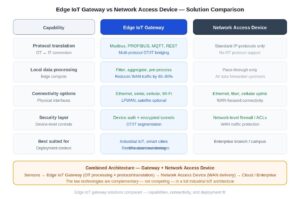
Edge gateways focus primarily on interacting with devices located at the network edge. They collect data from sensors and industrial equipment while performing local processing and protocol translation.
Network access devices, on the other hand, concentrate on connecting networks together. Their role involves managing traffic flows, establishing secure connections, and ensuring reliable communication between distributed sites and centralized infrastructure.
In many deployments, both technologies work together. A gateway gathers data from local devices, and an access device then ensures that the processed data reaches centralized systems securely.

Processing Data at the Edge Versus Managing Network Traffic
One of the defining differences between these technologies lies in how they handle data.
Edge gateways process and filter information before sending it across the network. This reduces bandwidth consumption and improves system responsiveness.
Network access devices focus on routing and transmitting data across networks. They ensure that information reaches its destination efficiently and securely but typically do not perform extensive data processing.
Combining both approaches allows organizations to build efficient architectures where only relevant information travels across the network while critical decisions can still occur locally.
Security and Reliability in Industrial Connectivity
Industrial networks often operate in environments where reliability and security are critical. Infrastructure supporting transportation systems, manufacturing plants, energy facilities, or utilities cannot afford communication disruptions.
Edge gateways frequently include built-in security mechanisms such as authentication, encryption, and device access control. These features protect sensitive operational data while ensuring that only authorized devices connect to the network.
Network access devices also contribute to security by supporting VPN connections, traffic segmentation, and monitoring capabilities that protect data traveling across wide-area networks.
Together, these technologies form layered security architectures that safeguard both edge devices and centralized systems.
Supporting Large-Scale IoT Deployments
The number of connected devices across industrial networks continues to grow rapidly. In many environments, thousands of sensors and machines may operate simultaneously.
Managing this scale requires infrastructure capable of supporting large device populations while maintaining stable connectivity.
Edge gateways help manage device communication locally while filtering data before it travels across the network. This prevents network congestion and ensures critical information reaches monitoring platforms quickly.
Network access devices support these deployments by providing reliable connectivity between distributed locations and central systems, enabling large-scale networks to function efficiently.
Integration with Enterprise and Cloud Platforms
Industrial IoT systems rarely operate in isolation. Data collected from sensors and machines often feeds into enterprise applications that support analytics, automation, and operational decision-making.
Edge gateways connect operational technology environments with modern IT platforms, allowing organizations to analyze industrial data alongside enterprise information.
Network access devices ensure that this data can travel across networks securely, connecting remote infrastructure to cloud services and centralized management platforms.
This integration enables organizations to gain deeper insights into operational performance while improving efficiency across industrial processes.
The Future of Edge Networking and IoT Connectivity
As industrial systems become increasingly digital, edge computing and distributed networking will continue shaping how organizations manage data.
Artificial intelligence is beginning to move closer to the edge, allowing systems to analyze sensor data locally and automate operational decisions. At the same time, emerging technologies such as private 5G networks are expanding connectivity options for remote infrastructure.
These developments will increase the importance of both gateways and access devices in industrial networks. Gateways will handle local intelligence and device communication, while access devices will ensure secure connectivity across expanding network environments.
Organizations investing in these technologies today are positioning themselves to support the next generation of connected infrastructure.
Conclusion
Industrial networks are evolving rapidly as IoT deployments expand across industries and infrastructure systems. Managing the growing flow of data generated by sensors, machines, and connected devices requires flexible network architectures capable of supporting both edge processing and reliable connectivity.
Edge gateways enable local data processing and device integration, while network access devices provide secure communication between distributed locations and centralized platforms. Together, these technologies create a balanced architecture that supports scalable and resilient connectivity.
By understanding the roles of each technology, organizations can design networks that handle increasing data demands while maintaining performance, security, and operational efficiency.
Edge IoT Gateway FAQs
- What is an edge IoT gateway?
An edge IoT gateway is a device that connects sensors, machines, and industrial equipment to network infrastructure while collecting, processing, and transmitting data to cloud or enterprise systems. - How does an edge IoT gateway differ from network access devices?
An edge IoT gateway focuses on connecting and managing IoT devices at the network edge, while network access devices primarily handle secure connectivity and data transport between networks or remote locations. - Why are edge IoT gateways important for industrial networks?
Edge IoT gateways enable local data processing, reduce network latency, and help manage communication between devices and centralized platforms in industrial IoT environments. - What role do network access devices play in connectivity?
Network access devices provide secure communication between remote sites and core networks, ensuring reliable data transmission across enterprise or service provider networks. - Can edge IoT gateways process data locally?
Yes, many edge IoT gateways include computing capabilities that allow them to analyze, filter, or preprocess data before sending it to centralized systems or cloud platforms. - Are edge IoT gateways used in smart infrastructure projects?
Yes, they are widely used in smart cities, transportation systems, industrial automation, and energy infrastructure to connect sensors and devices across distributed environments. - How do network access devices improve network reliability?
Network access devices support routing, traffic management, redundancy, and secure communication protocols that ensure stable connectivity between remote infrastructure and central networks. - What security features are commonly found in edge IoT gateways?
Edge IoT gateways often include encryption, authentication, secure boot, firewall capabilities, and device management tools that protect data and connected devices. - Can organizations deploy both technologies together?
Yes, many industrial networks use both edge IoT gateways and network access devices. The gateway handles device connectivity and edge processing, while the access device manages wide-area network communication.
10. What industries benefit most from edge IoT gateways and network access devices?
Industries such as manufacturing, transportation, utilities, smart cities, and energy infrastructure rely heavily on these technologies to support reliable and scalable IoT connectivity.