Tech
Dual-Use Technology Investing: How Venture Capital Evaluates Civilian and Defense Startups

| Key Takeaways
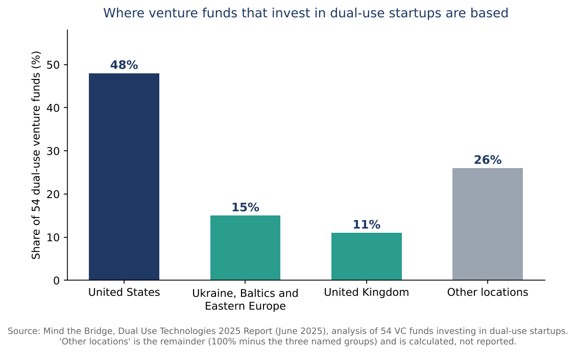
• Dual-use technology serves both civilian and defense customers, so a startup can build commercial revenue while it pursues slower government procurement. • Mind the Bridge identified 54 venture funds worldwide that invest in dual-use startups, with 48% based in the United States and 11% in the United Kingdom. • Most venture capital firms avoid direct weapons contracts but back sensors, software, AI and cybersecurity whose technology can serve both markets. • Foreign direct investment screening and government scrutiny shape how dual-use rounds are structured and how exits are planned. |
What counts as dual-use technology in venture capital?
Dual-use technology is technology with both civilian and military applications, which means a single product can serve commercial customers and defense buyers. A recent Mondaq analysis of dual-use investing describes the category as items designed for commercial use that can also serve battlefield, security or weapons purposes, with drones, artificial intelligence, cybersecurity systems and quantum technologies as typical examples.
The idea is older than the current investment cycle. GPS satellites are a widely cited example of military technology that was later repurposed for consumer use, and a perspective on why investors are funding dual-use companies notes that many venture capitalists now actively seek opportunities in this area. The same piece points to infrared sensors, originally designed to detect enemy presence from military vehicles, which now power night-vision systems in cars that help drivers spot people or animals up to about a hundred yards away.
For founders, the practical test is whether the underlying capability can be sold twice: once into a commercial market with its own revenue cycle, and once into defense or security programs. Investors reviewing an early-growth portfolio focused on deep and defense technology will recognize this pattern in artificial intelligence, quantum, robotics and security companies, where the same engineering work supports more than one buyer.
Why are venture investors paying more attention to dual-use companies now?
Rising defense budgets and geopolitical tension have made defense-adjacent technology a priority for governments, investors and startups at the same time. Mind the Bridge’s 2025 report names those drivers and adds that critical military capabilities, from AI-enabled surveillance to autonomous systems, will come not only from established primes but also from agile startups.
Public money is following the same logic. The Mind the Bridge Dual Use Technologies 2025 Report states that the European Union committed 1.5 billion euros to defense-related research and development in 2024 through initiatives such as EDIRPA and the European Defence Fund. It also reports a 400 million pound defense innovation pledge from the United Kingdom, a doubling of Germany’s military procurement budget, and a NATO Innovation Fund with 1 billion euros that has begun backing dual-use startups across member states.
Exit logic adds to the appeal. The Mondaq analysis observes that dual-use assets can interest both defense primes and private equity buyers, giving investors a wider set of exit options than a purely civilian or purely military company would offer.
The appeal is not limited to a single region. Mind the Bridge reports that 15% of the 54 funds it identified are located in Ukraine, the Baltics and Eastern Europe, particularly Poland and Czechia, reflecting a heightened regional focus on defense and security innovation. The same report describes Israel as a pioneer of the model, turning military-born innovation into a startup powerhouse, while the United States maintains programs such as DIU, AFWERX and NSIN to bring commercial technology into defense.
How do dual-use technologies differ from purely military ones?
Dual-use products have a civilian market and can be adapted for defense, while purely military products such as weapons and ammunition sit outside what most venture funds will back. As the perspective above explains, most venture capitalists avoid direct weapons contracts because that technology usually cannot be redeployed in civilian markets under security regulations.
The examples that tend to attract venture money are technologies that moved between the two worlds. The table below collects three cited in that discussion.
| Technology | Defense-related origin | Civilian use today |
| GPS satellites | Military technology | Consumer location applications |
| Infrared sensors | Detecting enemy presence from military vehicles | Night-vision systems in cars |
| Drones | Military buyers account for about half of one leading U.S. maker’s sales | Remaining sales go to non-military customers |
What risks do dual-use investors have to manage?
The main risks are government scrutiny, slow procurement and complicated ownership structures. Mondaq notes that dual-use companies stay subject to close government attention, including foreign direct investment screening, while Mind the Bridge describes a valley of death for startups after initial pilots because procurement still follows older models.
Deal terms reflect this. The Mondaq piece says investors in dual-use companies may negotiate board observer seats, information rights and rights over future use of the technology. It also describes private capital investors splitting some portfolio companies into separate military and non-military arms linked by licensing agreements, a structure designed to widen the pool of acquirers for the civilian business while keeping the higher-value military component for a targeted sale.
Adoption is the second hurdle. Mind the Bridge quotes an industry executive explaining that many armed forces are unaccustomed to working with startups at technology readiness level six, that startup fragility raises survivability concerns, and that scaling and field deployment remain bottlenecks.
Dual-use also reaches beyond hardware. Mondaq points out that sensitive personal data is now expressly treated as a dual-use asset with national security implications, which extends the category into data-heavy software companies. Diligence on such a company requires a detailed understanding of its financing structures, since some stakes come with extensive governance rights.

How do investors structure exposure to dual-use companies?
Investors can take minority stakes in early-growth rounds or acquire controlling stakes, and some combine both approaches. The choice matters because Mind the Bridge reports that most defense startups lack the infrastructure to scale hardware production on their own.
Elron Ventures describes a combination of this kind on its website: early-growth investments across cybersecurity, AI, deep tech and defense tech, alongside an M&A strategy aimed at acquiring controlling stakes in early-stage dual-use defense-tech companies. A control strategy gives the buyer direct responsibility for scaling, while the minority track keeps exposure to a wider set of young companies.
What should founders prepare before approaching dual-use investors?
Founders should be able to show commercial traction in a civilian market, a credible route to defense or security customers, and a financing plan that survives slow procurement. Each element answers a risk that investors already track.
Civilian revenue demonstrates that the technology works outside a single government program. A defined path to defense buyers, such as an existing pilot or a named program, shows that the second market is more than a slide in a deck. Financing needs to cover the gap between pilot and contract, which Mind the Bridge identifies as the point where many startups stall.
Ownership and governance deserve early attention too. Because foreign direct investment screening can apply, clean cap tables, clear intellectual property ownership and a view on which parts of the technology could be separated for a civilian sale all make diligence easier. Founders who can explain those points in plain terms tend to shorten the conversation, since the investor does not have to reconstruct the structure from scratch.
Finally, founders should expect questions about exit. Dual-use companies can attract defense primes and private equity, and a founder who understands both buyer types can present a more flexible story than one who assumes a single outcome.
Frequently Asked Questions
What is dual-use technology?
Dual-use technology is technology designed for commercial or civilian use that can also serve military, security or defense purposes. Drones, artificial intelligence, cybersecurity systems and quantum technologies are common examples.
Do venture capital firms invest in weapons?
Most venture capital firms avoid direct weapons contracts because that technology usually cannot be redeployed in civilian markets under security regulations. Many instead back startups whose technology can be repurposed for civilian use.
How many venture funds invest in dual-use startups?
Mind the Bridge identified 54 venture funds worldwide that invest in dual-use startups in its 2025 report. Nearly half, 48%, are based in the United States and 11% in the United Kingdom.
Why are dual-use companies attractive at exit?
Dual-use companies can interest both defense primes and private equity buyers, which gives investors a broader set of possible acquirers than a purely civilian or purely military business.