Tech
Choosing Sports Broadcast Equipment for Multi-Venue Coverage


| Key Takeaways
• Remote-production (REMI) workflows let a single centralized control room manage feeds from multiple venues, cutting on-site crew size compared with a traditional outside-broadcast truck. • Portable field units used in sports broadcasting can now support up to 4K60 10-bit HDR video with roughly 300 milliseconds of glass-to-glass latency. • The global sports broadcasting technology market was valued at about $90.13 billion in 2026 and is projected to reach roughly $154.53 billion by 2035, according to Precedence Research. • Programs moving from a single fixed camera to multi-venue coverage typically need to budget for bonded connectivity, at least one production-grade field unit, and cloud-based distribution tools rather than a traditional OB truck. |
What equipment do sports organizations need to broadcast live from multiple venues?
Covering multiple venues live comes down to a portable field unit per location, enough bonded network capacity to hold a stable connection at each site, and a way to bring every feed into one place for directing and switching. Sports coverage has traditionally meant sending a full outside-broadcast truck and crew to each venue, which becomes expensive fast once a school, league, or regional broadcaster is covering more than one game on the same weekend. Field units built for this kind of work now support ground, water, and aerial coverage from the same core hardware, with native 5G connectivity for crowded venues where a single cellular link would otherwise struggle. Programs already running this model at a smaller scale are covered in more detail via programs already running at the collegiate level, which lists deployments across a range of college athletics departments.
How does remote production compare with a traditional outside-broadcast truck?
Remote production, often called REMI, keeps cameras and a small crew at the venue while directing, switching, and graphics happen at a centralized studio elsewhere, compared with a traditional OB truck that brings the entire control room on-site. The practical difference shows up in crew size, setup time, and how many events a single production team can realistically cover in one weekend.
| Approach | Typical on-site crew | Setup time | Best fit |
| Traditional OB truck | 8-15+ | Several hours to a full day | A marquee event at a single, well-served venue |
| Centralized remote production (REMI) | 1-3 per venue | Under an hour | Multiple venues covered from one control room |
| Single-operator portable unit | 1 | Minutes | Lower-tier or supplemental coverage needing fast turnaround |
A comparison of common live-sports production approaches by crew size and setup time. Figures are typical ranges, not fixed specifications.
A centralized workflow like this is described in more depth on a centralized remote-production workflow, which covers how camera control, on-air status, and return-feed monitoring are handled remotely rather than from an on-site truck.
How big is the market for sports broadcasting technology, and why does it matter for equipment choices?
The sports broadcasting technology market is large and growing quickly enough that equipment decisions made today are likely to need multi-venue and remote-production capability within a few years, not just a single-camera setup. a recent industry market-sizing report values the global sports broadcasting technology market at roughly $84.83 billion in 2025, rising to about $90.13 billion in 2026 and a projected $154.53 billion by 2035, a compound annual growth rate of about 6.18% over that period, with North America holding roughly 37% of the market in 2025.
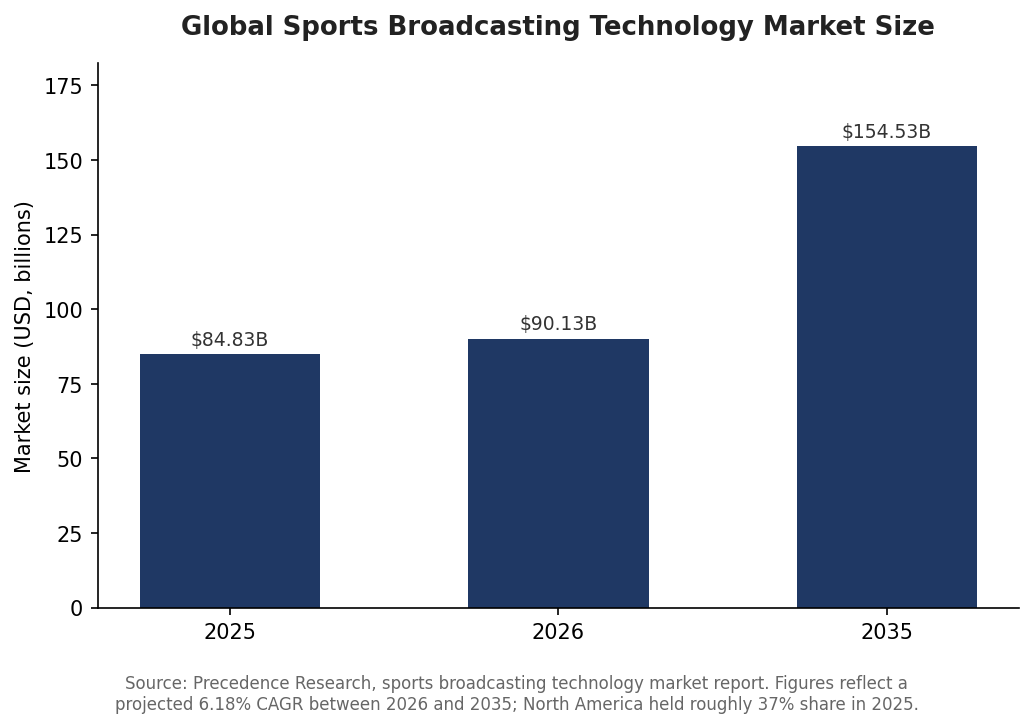

Global sports broadcasting technology market size by year. Source: Precedence Research.
What should a college or regional sports program budget for its first multi-venue setup?
A program moving beyond a single fixed camera should budget for at least one bonded field unit per venue it wants to cover live, enough network capacity to hold a stable 1080p or 4K stream at each site, and a distribution workflow that can push the same feed to multiple destinations at once. Field units built for this level of production typically support up to 4K at 60 frames per second with 10-bit HDR, glass-to-glass latency down to around 300 milliseconds, and up to 16 audio channels for full production sound, specifications aimed at replacing rather than supplementing a traditional truck-based setup. Smaller programs that need a lighter starting point often begin with a compact bonding encoder built for single-operator setups before scaling into a full multi-venue, multi-crew workflow. Vendor-published figures cited across the industry suggest remote-production models like these can cut live-production costs by up to 70% compared with sending a full crew and traditional infrastructure to every venue, though actual savings vary by event type and existing infrastructure. Broader market context is available through a sports-specific solutions page, which outlines coverage options across ground, water, and aerial formats.
What other production feeds can the same equipment support beyond the main broadcast?
The same field units used for a main broadcast feed can typically also output a separate fan-engagement stream, a backup feed for redundancy, and a dedicated analytics or officiating feed, all from the same on-site hardware rather than requiring separate cameras and crews for each. A fan-engagement feed is often a second, differently-framed camera angle pushed to social platforms while the primary feed goes to the main broadcast. A backup feed protects against a single point of failure on the primary path, which matters most for marquee events where a dropped signal is not an option. Beyond-broadcast feeds, covering things like video-assistant-referee review angles or sports-analytics camera positions, are a newer category that has grown alongside data-driven officiating and coaching tools. For a program planning its first multi-venue rollout, the practical takeaway is that a single properly specified field unit and connectivity plan can often cover more than just the primary broadcast, which changes the cost math compared with treating each feed as a separate production. A program that starts with a single-camera main feed can typically add a fan-engagement angle or a backup path later without replacing the underlying connectivity setup, since the bonded network layer already has spare capacity built in for exactly this kind of expansion.
How should a multi-sport athletics department prioritize its first two or three venues?
A multi-sport athletics department should prioritize the venues with the highest attendance or the most consistent fan demand first, since those events generate the clearest return on a bonded field unit and typically justify a dedicated setup rather than a shared, rotating one. Football and basketball venues tend to have the most reliable cellular coverage already, given stadium-grade network investment in most markets, which makes them a lower-risk starting point technically as well as commercially. Lower-attendance sports, meanwhile, are often better served by a single portable unit that rotates between venues on a schedule, since the equipment cost of a dedicated setup at every field is difficult to justify against modest streaming demand. This kind of phased rollout, high-demand venues first with dedicated equipment, everything else covered by a shared rotating unit, tends to produce a faster return on investment than trying to equip every venue simultaneously from day one.
Frequently Asked Questions
What is REMI in sports broadcasting?
REMI, or remote integration, is a production model where cameras stay at the venue while directing, switching, and graphics are handled from a centralized studio elsewhere.
Do you need a broadcast truck to cover a live sporting event?
No; many sports organizations now cover live events using portable, bonded-IP field units and centralized remote-production workflows instead of a dedicated outside-broadcast truck.
How much can remote production reduce live-sports production costs?
Vendor-reported figures suggest remote-production workflows can reduce live-production costs by up to 70% compared with sending a full crew and traditional infrastructure to every venue, though actual savings vary by event and setup.
How large is the sports broadcasting technology market expected to become?
Precedence Research projects the global sports broadcasting technology market to grow from about $90.13 billion in 2026 to roughly $154.53 billion by 2035.