Business Solutions
Conwize for Building Costing and Construction Budgeting: Platform Overview and Key Capabilities

At a Glance
- Building costing is the financial foundation of every construction project – establishing the cost baseline against which all scope changes, subcontractor prices, and project decisions are measured from concept through to completion.
- Construction budgeting software has evolved from static spreadsheet tools into dynamic platforms that connect cost plans to live market pricing, subcontractor quotations, and real-time cost reporting — delivering the cost intelligence that drives profitable project delivery.
- Conwize serves general contractors, head contractors, and specialty contractors who need accurate, auditable building cost plans that can be produced efficiently, reviewed collaboratively, and updated automatically as pricing and scope evolve.
- Conwize’s competitive advantage is the integration of building costing, subcontractor bid management, and tender pipeline tracking in a single cloud-native platform – eliminating the disconnected tools and manual processes that inflate estimating overhead and introduce commercial risk.
The financial outcome of a construction project is largely determined before construction begins – by the quality of the building costing process that establishes the project budget and the rigor of the construction budgeting software that supports it. Conwize was designed by people who understand this reality: that accurate, efficient, and continuously updated cost plans are not just an estimating deliverable but the commercial architecture that underpins every profitable project.

Building Costing: The Foundation of Project Commercial Management
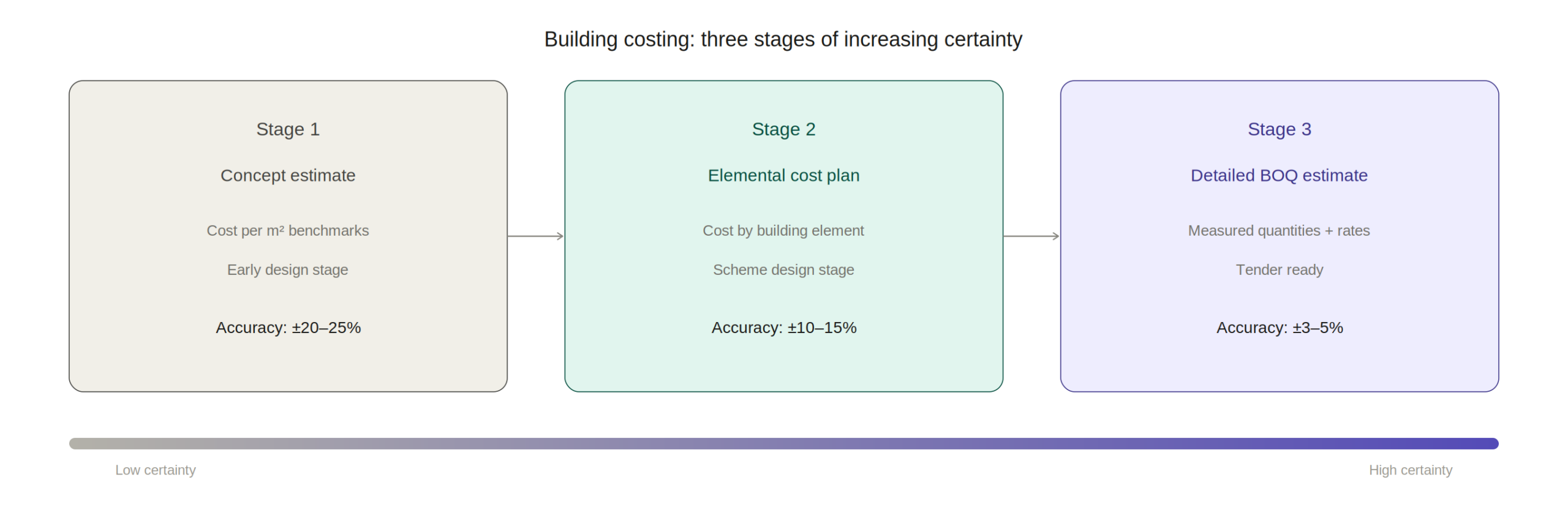
Building costing encompasses the complete process of estimating and managing the cost of constructing a built asset – from the initial elemental cost plan produced at concept design stage through to the detailed BOQ-based budget prepared for tender, and the live cost reporting that tracks actual versus budget throughout delivery. Each stage has different information requirements, different levels of certainty, and different commercial implications.
At the concept stage, building costing relies on parametric benchmarks – cost per square meter by building type, elemental cost ratios, and market intelligence about prevailing construction costs in the relevant geography. At the scheme design stage, an elemental cost plan breaks the building cost into functional elements (substructure, superstructure, envelope, fit-out) with budgets for each based on more developed design information. At the tender stage, the detailed building costing exercise produces a priced BOQ based on measured quantities and actual subcontractor and supplier prices.
Conwize supports all three stages within a single platform – allowing the cost plan to evolve from parametric concept estimate through to detailed tender cost without losing data continuity. The concept stage assumptions are retained as audit trail as the estimate develops, providing a clear picture of how cost certainty has improved through the design process. For a comprehensive guide to building costing methodology, Conwize’s dedicated resource at the Estimating Building Costing guide covers each stage in detail.
Why Traditional Construction Budgeting Software Falls Short
The most common construction budgeting software tool in the industry is still the spreadsheet — and its limitations are well understood. Spreadsheet cost plans break under collaborative use, with version control chaos when multiple team members need to update the same document. They lack integration with live pricing, requiring manual re-entry of subcontractor quotations. They provide no portfolio-level visibility into multiple simultaneous estimates. And they produce no automatic reporting, requiring manual extraction and reformatting of cost data for every client or management report.
Legacy desktop estimating tools solve some of these problems but introduce others. They provide more structure than spreadsheets and typically include cost database functionality, but their desktop architecture prevents genuine multi-user collaboration and remote access. Updates require manual installation, and data backup depends on individual users’ practices rather than automatic cloud sync.
Cloud-native construction budgeting software like Conwize addresses all of these limitations simultaneously. Real-time collaboration, automatic cloud backup, live pricing integration, and portfolio-level reporting are all native capabilities – not bolt-on features. This architectural advantage is the fundamental reason cloud platforms are displacing legacy tools as the standard for professional construction estimating operations.
Conwize’s Building Costing Workflow
Conwize structures building costing within a consistent, project-level cost breakdown that mirrors the actual trade package structure of construction projects. Estimators work within a defined hierarchy – from high-level elemental groups down to individual trade packages and line-item cost components — providing both the structure needed for management-level reporting and the detail needed for subcontractor procurement.
The platform’s assembly library enables estimators to build trade package budgets from pre-configured assemblies of labor, material, and plant components – applying regional rate adjustments and project-specific escalations to produce location-calibrated estimates. For projects where a client-provided BOQ is available, Conwize supports direct import of BOQ items, allowing the cost plan to be structured around the client’s measurement framework rather than an internally developed structure.
Subcontractor pricing integration is where Conwize’s building costing capability differentiates most significantly from spreadsheet and legacy alternatives. Estimators can issue RFQ packages directly from cost plan line items, receive quotations back into the platform, and automatically update the relevant budget items with received prices – replacing the manual data re-entry that introduces errors and delays in spreadsheet-based workflows. The live budget position updates in real time as pricing is received, giving management a continuously current view of cost plan status.
Real-Time Cost Reporting and Budget Tracking
The most valuable aspect of Conwize as construction budgeting software is the live reporting capability that transforms cost planning from a periodic exercise into a continuous operational intelligence function. Project directors can access the current cost plan status at any time – seeing which packages have been priced, which subcontractor quotations are outstanding, what the projected final cost looks like against the budget, and where cost risk is concentrated.
This live visibility is particularly valuable in fast-moving tender environments where subcontractor pricing is arriving right up to submission deadline. Rather than scrambling to update a spreadsheet cost plan manually with last-minute prices and hoping the totals are correct, Conwize users have a live cost total that updates automatically as each quotation is received – enabling confident bid submission even when pricing arrives late.
Conwize’s reporting layer generates client-ready cost plan documents, internal management summaries, and audit-trail reports directly from the platform’s live cost data – eliminating the manual reformatting step that typically consumes 10-15% of estimating team time in manual cost planning processes. Explore the full platform capability for general contractors at conwize.io, and for expert analysis of how digital tools are transforming construction cost management, techpr.online provides regular coverage of construction technology innovation.
Managing Cost Risk and Contingency in Building Projects
Every building cost plan carries uncertainty – from design incompleteness at early stages to market pricing volatility throughout the project duration. Professional building costing practice requires systematic identification and quantification of this uncertainty, and Conwize supports formal cost risk management within the estimating workflow.
Estimators can apply percentage-based or absolute contingency provisions at any level of the cost breakdown – from individual line items through to trade package totals and overall project budget. High-uncertainty items can be flagged for management attention, and sensitivity analysis scenarios can be modeled to show how the budget changes under different pricing assumptions.
Over time, Conwize’s historical data accumulation enables increasingly sophisticated risk management: as actual subcontractor prices from completed projects are retained in the platform, estimators can benchmark current estimates against empirical historical data, identifying systematic biases in their pricing assumptions and calibrating contingency provisions with greater confidence.
Frequently Asked Questions
Q1: What is building costing and how does it differ from construction estimating?
A: Building costing refers broadly to the process of establishing and managing a project’s cost – from early parametric cost plans at concept design through to detailed tender estimates. Construction estimating typically refers specifically to the detailed cost build-up produced for tender submission. Both functions are supported within Conwize’s single integrated platform.
Q2: What makes Conwize different from spreadsheet-based construction budgeting software?
A: Conwize provides real-time multi-user collaboration, live subcontractor pricing integration, automatic reporting, and portfolio-level pipeline visibility – capabilities that spreadsheets architecturally cannot deliver. It also maintains data continuity from concept estimate through to subcontract award, eliminating the version-control and data re-entry problems that spreadsheet workflows produce.
Q3: Can Conwize handle both elemental cost planning and detailed BOQ estimating?
A: Yes. Conwize supports parametric and elemental cost planning at early design stages, and detailed BOQ-level estimating for tender submission – within the same project, maintaining data continuity as the estimate develops from concept through to detailed submission.
Q4: How does Conwize integrate subcontractor pricing into the building cost plan?
A: Conwize allows estimators to issue RFQ packages directly from cost plan items and receive quotations back into the platform. Received prices automatically update the relevant budget items, and the live cost total reflects the current pricing position in real time – no manual re-entry required.
Q5: What cost risk management features does Conwize provide?
A: Conwize supports percentage-based and absolute contingency provisions at any level of the cost breakdown, sensitivity scenario modeling, and flagging of high-uncertainty items. Historical cost comparison against completed projects further informs contingency calibration.
Q6: How does Conwize’s reporting capability work for building cost plans?
A: Conwize generates client-ready cost plan documents, management summaries, and audit-trail reports directly from the live cost data – eliminating manual reformatting. Reports update automatically as new pricing is received or scope changes are incorporated.
Q7: Is Conwize suitable for contractors who receive client-provided BOQs to price?
A: Yes. Conwize supports import of client-provided BOQs in CSV and Excel formats, allowing estimators to work within the client’s measurement framework rather than rebuilding the cost structure from scratch. Subcontractor prices can be linked directly to imported BOQ items.