Tech
Book Digitization, Copy Stands, and Digitizing the Autochrome Process

Key Takeaways
|
Why does book binding determine how fast a collection can be digitized?
A large part of the cultural heritage community works on digitizing rare and delicate bound materials, and the binding itself is often what dictates how quickly that work can safely proceed. Phase One’s book digitization solutions are built around this reality directly: digitization of books often requires special attention to the binding, which can be fragile, and that fragility can become the limiting factor when an institution is looking for a fast capture turnaround. A binding that can’t be opened flat, for instance, rules out certain capture approaches entirely, regardless of how fast the camera itself can shoot.
How does a copy stand actually speed up the capture process?
Copy stands are the workhorse tool behind this entire workflow. Using a leveled glass plate with the camera set for fixed focus on a copy stand accelerates the capture process considerably, since the operator no longer needs to refocus or reposition for every single page. Photographing both pages of an open book at the same time, using one or two cameras, increases productivity further still. Institutions with valuable collections often maintain a dedicated photographic studio built around exactly this workflow, both to provide public access and research copies and to protect fragile originals from the wear and handling that repeated researcher access would otherwise cause.
How much faster is rapid-capture digitization than traditional scanning?
The gap between purpose-built digitization systems and conventional scanning equipment is large enough to change what’s realistically achievable for a big collection under time pressure. Fast, reliable digitization solutions built for transparent film and glass plate negatives can achieve a capture rate of roughly one image per second, up to 400 times faster than flatbed, drum, or virtual-drum scanners.
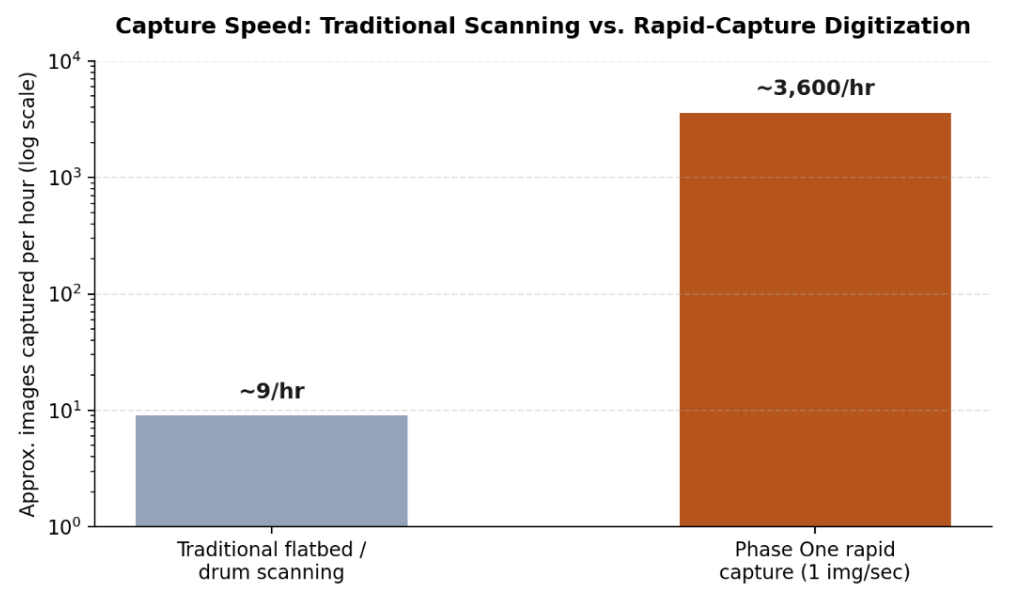

Approximate capture speed comparison between traditional flatbed or drum scanning and rapid-capture digitization (log scale).
That speed difference matters most because preserving the past is often a race against time: much of the material institutions are digitizing has a limited physical lifespan before it’s gone for good, so a workflow capable of moving through a large collection quickly can mean the difference between preserving a complete archive and losing part of it before the work is finished.
What copy stand configurations exist for different collection types?
| Copy stand type | Best suited for |
|---|---|
| Single-camera stationary stand | Smaller digitization projects needing a stable, long-lasting platform with one high-resolution camera system. |
| Dual-camera book system | Rare books that cannot be opened flat, using an automated dual-page capture workflow with two cameras. |
| AutoColumn large-format stand | Large, flat, and thin objects such as maps, newspapers, and drawings, with a metal cover board for secure magnetic positioning. |
| Motorized 2-motion stand | Larger flat objects requiring a bigger baseboard and flexibility across different lens configurations. |
What does digitizing the autochrome process actually involve?
Understanding the autochrome process itself helps explain why these plates need such careful handling. Autochrome plates, a color photography process that flourished from 1907 into the 1930s, present a distinct challenge inside cultural heritage digitization: each autochrome is a unique transparency image with no negative counterpart, meaning there is no duplicate to protect against a mistake during capture. Phase One’s film and glass plate digitization solutions address this class of material with a film capture stage that provides an adjustable, geared support mechanism compatible with a range of carriers built specifically for glass plate negatives, alongside most popular film strip and sheet formats. Glass plate carriers are made of milled high-grade aluminum with an optically-optimized glass base, built to hold plates of varying and sometimes irregular sizes securely and consistently during capture.
The conversion process for this kind of transparent, historical material is genuinely open to interpretation, since the base material and the chemical processing used varies, especially for the earliest glass plates where the specific chemicals and development process are often unknown. Two rolls of film, or two glass plates, may behave very differently, both in the physical characteristics of the original base material and in how that material was originally developed, which is part of why uniform, controlled illumination and consistent color reproduction matter so much throughout the capture process.
What does a well-run digitization workflow need beyond the camera and stand?
- Specialized workflow software: a rapid-capture solution paired with cultural heritage editing tools speeds up both capture and the post-production work of converting negatives to positives and correcting color.
- Simplified interfaces for large volumes: a streamlined capture mode allows less-specialized operators to handle high-volume digitization projects without sacrificing consistency.
- Accurate object identification: integrated barcode scanning during capture helps ensure every digitized object is named and tracked correctly across a large collection.
- Material-appropriate handling: different physical formats, bound books, flat documents, glass plates, each require their own specialized stand and carrier configuration rather than a one-size-fits-all setup.
What quality standards guide professional cultural heritage digitization?
Institutions digitizing valuable or fragile collections don’t simply capture an image and call it done; the output has to meet recognized quality benchmarks that ensure the digital copy is actually fit for long-term preservation and research use. Standards such as FADGI (the Federal Agencies Digital Guidelines Initiative), Metamorfoze, and ISO 19264 define specific technical targets for resolution, color accuracy, and tonal range, giving institutions a common language for specifying what “high quality” actually means in measurable terms rather than a subjective judgment. Meeting these benchmarks typically requires resolution around 300 pixels per inch or higher for most collection material, alongside carefully controlled, even illumination and accurate color calibration throughout the capture process.
| Standard | What it primarily governs |
|---|---|
| FADGI (Federal Agencies Digital Guidelines Initiative) | A star-rating system for image quality covering resolution, tonal response, and color accuracy, widely referenced across libraries and archives. |
| Metamorfoze | A Dutch national standard for image quality in cultural heritage digitization, with defined preservation and access quality tiers. |
| ISO 19264 | An international standard defining objective image quality analysis methods for cultural heritage reproduction. |
What happens to digitized material after capture?
Capture is only the first stage of a complete digitization program. Once an image is captured, it typically passes through post-production steps that can include cropping and alignment, negative-to-positive conversion for film and glass plate material, color correction against calibrated reference targets, and quality control review against whichever standard the institution has adopted. The resulting files are then usually stored in an uncompressed or losslessly compressed master format intended for long-term preservation, alongside smaller derivative files optimized for public access and online display. Metadata capture, recording what the object is, where it came from, and any relevant rights information, runs alongside this whole process, since a beautifully captured image with poor metadata is far less useful to future researchers than a properly documented one.
Frequently Asked Questions
Why can’t hidden or delicate bindings just be opened flat for faster scanning?
Forcing a fragile binding open flat risks damaging the book permanently. Digitization systems built for rare books instead use a dual-camera setup that photographs both pages simultaneously at whatever angle the binding safely allows, rather than forcing the book into a position that risks the original.
What makes autochrome plates harder to digitize than an ordinary photograph?
Each autochrome is a unique transparency with no negative, so there’s no backup if a plate is damaged during handling or capture. The plates are also physically fragile glass, and the exact chemical composition of early examples is often unknown, which makes consistent, accurate color reproduction more challenging than with a standard, well-documented film stock.
How much faster is rapid-capture digitization really, in practical terms?
Systems capable of roughly one image per second can be up to 400 times faster than flatbed, drum, or virtual-drum scanners, which can turn a project that would take months of scanning into one that takes days.
Does a copy stand work for objects other than books?
Yes. Different copy stand configurations exist for flat objects like maps and newspapers, for glass plate negatives and film, and for bound books specifically, each with hardware suited to that particular format’s handling and stability needs.