Tech
Bonded Streaming and IP Bonding: How Contribution Encoders Actually Work

Key Takeaways
|
What is IP bonding, and why was it actually invented?
IP bonding was invented to address a specific, practical problem: for anyone trying to deliver live streams via early cellular technologies like 3G and 4G, a single connection was never sufficient for throughput or reliability on its own. LiveU’s own explanation of the technology describes how bonded streaming solves this: technologies use multiple cellular connections, plus available WiFi and Ethernet, to improve both characteristics simultaneously, enabling contributors to affordably deliver high-quality video from locations that would otherwise have been inaccessible, whether practically or economically.
How does the packet distribution and reassembly process actually work?
Every contribution encoder relies on this same underlying process. Under the hood, a compressed video file is divided into multiple packets, distributed across all available transport mechanisms at once. Once those packets are delivered to the cloud, they’re reassembled back into the original video file, which can then be distributed to multiple private or public destinations, including social media platforms. When a stream is sent to a decoder instead, the reassembled packets are typically input into a linear TV production through standard broadcast video outputs. This distributed-then-reassembled approach is exactly what lets bonded streaming survive the loss or degradation of any single connection without losing the overall stream.
What role does a dedicated transport protocol play in making bonding actually reliable?
Bonding multiple unpredictable cellular connections into one stable stream requires more than simply splitting data across them; it requires a protocol purpose-built for the job. LiveU Reliable Transport (LRT™) is a point-to-point, low-latency, high-resiliency protocol created specifically to accommodate the particular properties of cellular and LTE networks and the specific demands IP bonding places on them. One key capability is packet ordering, which simplifies reassembling video after packets travel over different transport mechanisms and inevitably arrive out of sequence. The protocol also applies dynamic forward error correction, a technique that improves both reliability and throughput by allowing lost data to be reconstructed rather than requiring retransmission.
What does a contribution encoder actually need to support in practice?
| Capability | Why it matters for contribution encoding |
|---|---|
| Multi-network bonding | Combining cellular, WiFi, Ethernet, and satellite connections maximizes available bandwidth and resiliency. |
| Frame-synced multi-camera support | Production-level encoders need to keep multiple camera feeds synchronized for multi-angle coverage. |
| HEVC/H.264 encoding options | HEVC delivers the same quality in roughly half the bandwidth, valuable when cellular capacity is limited. |
| Remote monitoring and management | Field teams need to troubleshoot and adjust encoder settings without requiring physical access to the unit. |
Point-to-point contribution encoders illustrate how these capabilities come together in a rackmount form factor: production-level 4K 10-bit HDR encoding supporting up to four fully frame-synced feeds over two bonded public IP connections, with optional cellular bonding available for extra resiliency or seamless failover when a primary connection degrades.
How widely relied upon has bonded streaming actually become?
Bonded cellular transmission has moved from a niche technical workaround to a mainstream newsgathering standard. A 2022 Broadcast Bridge survey of US regional TV stations found that most respondents used bonded cellular for roughly 80% of their news coverage, a figure that highlights how thoroughly this approach has replaced older, more expensive alternatives like satellite trucks for routine, day-to-day remote contribution. Bonded IP solutions generally deliver a strong combination of reliability, mobility, and cost efficiency, often at a fraction of the operational cost of satellite trucks or fixed fiber installations.
How is demand for the broadcast infrastructure behind bonded streaming actually growing?
The broader broadcast equipment category, which includes the encoders, decoders, and transmission infrastructure bonded streaming depends on, continues to grow steadily as the industry shifts toward IP-based workflows. IMARC Group’s broadcast equipment market analysis values the global market at $5.8 billion in 2025, projected to reach $8.3 billion by 2034, a compound annual growth rate of 3.82%. The report specifically credits rising demand for alternatives to existing broadcast infrastructure, since IP-based solutions enable broadcasters to reduce latency, improve content delivery, and streamline operations across many platforms simultaneously.
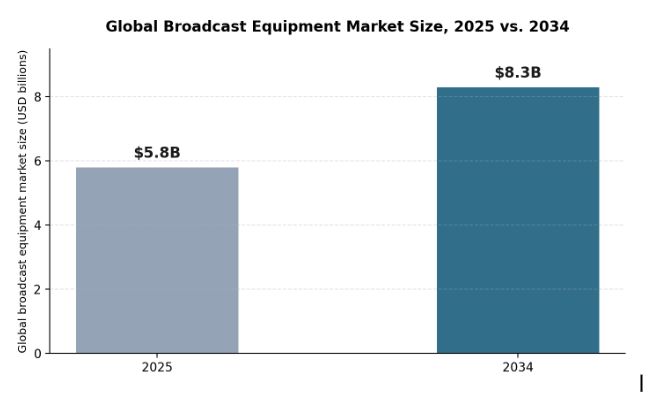

Global broadcast equipment market size, 2025 versus 2034, according to IMARC Group.
What should you actually check when evaluating a bonded streaming setup?
- How many connections can actually be bonded simultaneously? More available connections generally means higher resiliency and greater available bandwidth.
- Does it support both cellular and non-cellular transport? WiFi, Ethernet, and satellite options matter for venues where cellular coverage alone isn’t sufficient.
- What encoding options are available? HEVC support can meaningfully reduce bandwidth requirements compared to older H.264-only encoders.
- Can the unit be monitored and adjusted remotely? Central cloud management reduces the operational burden of troubleshooting units already deployed in the field.
How does bonded streaming actually handle a low earth orbit satellite connection?
Modern bonded streaming systems increasingly treat low earth orbit (LEO) satellite services, such as Starlink, as just another connection type to bond alongside cellular, WiFi, and Ethernet, rather than as an entirely separate transmission path requiring its own dedicated workflow. That matters practically for locations with poor or nonexistent cellular coverage, remote wilderness areas, rural events, or disaster zones where cell towers may be damaged or overwhelmed, since a bonded system can lean more heavily on the satellite connection precisely where cellular capacity is weakest, without requiring the operator to manually switch between systems mid-broadcast. Cutting production costs by using IP transmission over the public internet, private networks, or LEO connections is increasingly part of the same underlying bonding logic that made cellular bonding practical in the first place.
What operational lessons have two decades of bonded streaming deployment actually taught the industry?
Two decades of real-world bonded streaming deployment have surfaced a few consistent lessons for production teams. First, redundancy matters more than raw peak bandwidth in most field conditions, since a slightly lower but consistently available bitrate produces a more usable broadcast than a higher peak bitrate that periodically drops out. Second, the specific mix of network types bonded together should match the actual deployment environment, a dense urban event benefits from cellular diversity across multiple carriers, while a remote rural location benefits more from satellite backup. Third, remote monitoring and management capability has become a practical necessity rather than a convenience, since field crews increasingly need to troubleshoot connectivity issues without a dedicated engineer physically present at every single remote location a broadcast originates from.
Frequently Asked Questions
Is IP bonding the same thing as bonded streaming?
The terms are closely related. IP bonding refers to the underlying technique of combining multiple network connections into one path. Bonded streaming describes the broader practice of using that bonded connection to deliver live video.
Does bonded streaming only work with cellular networks?
No. While cellular bonding is common, bonded streaming can combine cellular connections with WiFi, Ethernet, and satellite links (including LEO satellite services), drawing bandwidth from whichever combination of networks is actually available at a given location.
What happens if one of the bonded connections drops during a live broadcast?
A well-designed bonding system continues transmitting over the remaining active connections, and technologies like dynamic forward error correction help reconstruct data lost during the disruption, so the overall stream typically continues without a visible interruption.
Why is HEVC encoding relevant to bonded streaming specifically?
HEVC (H.265) delivers the same video quality in roughly half the bandwidth of H.264, which matters directly for bonded cellular transmission, where available bandwidth is often the primary constraint on stream quality.