Tech
The Best Ways to Digitize Analog Film Without Losing What Made It Analog

Archives sitting on shelves of negatives, glass plates, and slides face a quiet but real deadline: analog film degrades, and every year that passes without digitization is a year closer to information loss that cannot be undone. The good news is that film digitization has matured well beyond the flatbed scanners most people picture. Here is an honest look at the main approaches available to an institution weighing this decision today, and where each one actually fits.
Flatbed scanning: the familiar starting point
Flatbed scanners are the most widely available option and the lowest barrier to entry, which is exactly why so many small archives start here. The tradeoff is speed and, at scale, consistency. Each frame is captured through a slow, mechanical pass, and results can vary depending on how consistently an operator loads and positions material. For a modest personal collection or a small batch of prints, this is often perfectly adequate. For a collection running into the thousands or tens of thousands of frames, the math stops working: the time cost compounds quickly.
Drum and virtual drum scanners: higher quality, higher overhead
Drum scanners have long been considered a high-quality option, particularly for capturing fine tonal detail in transparencies, and virtual drum scanners attempt to replicate that quality without the physical drum. Both, however, remain fundamentally slow, point-by-point or line-by-line capture methods. They also tend to require more specialized operator skill and ongoing maintenance than either flatbed or camera-based systems, which raises the effective cost per image once staff time is factored in alongside the equipment itself.
Camera-based digitization: built for volume without giving up quality
The more recent shift in serious archival digitization has been toward camera-based systems: a high-resolution digital sensor paired with a dedicated film capture stage, specialized film and glass-plate carriers, and copy-stand hardware, all built specifically to hold negatives, transparencies, and plates flat and properly illuminated during capture. Because the entire frame is captured in a single, near-instant exposure rather than built up progressively, throughput increases dramatically. One documented high-volume digitization workflow using an iXG camera system reports capture rates fast enough to process a full frame in a fraction of a second, cited as roughly 400 times faster than flatbed, drum, or virtual-drum scanning for comparable material.
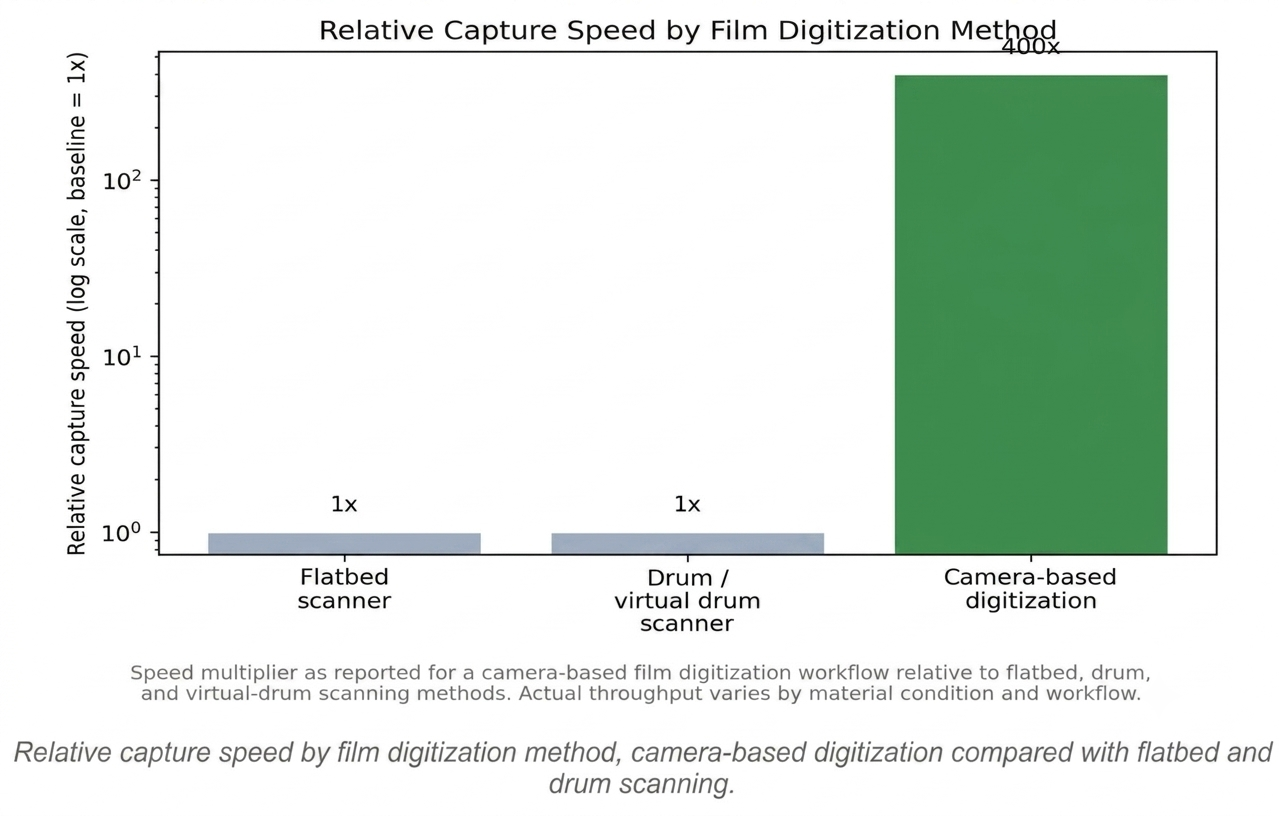

Relative capture speed by film digitization method, camera-based digitization compared with flatbed and drum scanning.
Does faster mean lower quality?
This is the question every archivist asks first, reasonably so, and the answer depends entirely on whether a program follows recognized technical benchmarks. Standards such as those maintained by the Federal Agencies Digital Guidelines Initiative, widely referred to as FADGI, and the Dutch Metamorfoze guidelines exist precisely to give institutions an objective way to verify image quality regardless of which capture method produced it. A camera-based system built around flat-field optics, precise focus tools, and accurate color profiling can meet the same three- and four-star quality benchmarks that a slower method targets, while doing it in a fraction of the time. Speed and quality are not automatically in tension; the real variable is whether the equipment and workflow were designed to hold quality steady at higher throughput.
What should actually drive the decision?
- Collection size: small, occasional digitization jobs rarely justify the cost of a dedicated camera-based setup, while collections in the thousands of items usually cannot avoid it on a cost-per-image basis.
- Material variety: mixed collections containing negatives, glass plates, slides, and bound volumes benefit from a modular setup that can switch between capture stages rather than requiring separate dedicated machines for each format.
- Compliance requirements: institutions submitting digitized material to federal, academic, or museum standards need to confirm their chosen workflow can actually document and pass the relevant FADGI or Metamorfoze star rating, not just claim high resolution.
- Staff capacity: drum and virtual drum scanning generally demand more specialized, ongoing operator expertise than a well-designed camera-based workflow, which matters for institutions without a dedicated imaging technician on staff.
There is no universally correct answer here, only a correct answer for a given collection’s size, format mix, and compliance needs. What has changed in recent years is that the fastest option is no longer automatically the lowest-quality one, which means the old tradeoff between speed and archival integrity is far less absolute than it used to be.
Frequently Asked Questions
Is camera-based film digitization actually faster than scanning?
Yes, documented workflows report camera-based capture running at roughly 400 times the speed of flatbed, drum, or virtual-drum scanning for comparable material, since the full frame is captured in a single exposure.
Does faster film digitization mean lower image quality?
Not inherently. Quality depends on whether the equipment and workflow are built to meet recognized benchmarks such as FADGI or Metamorfoze star ratings, regardless of the capture method used.
What type of archive benefits most from camera-based digitization?
Larger or mixed-format collections, such as those combining negatives, glass plates, and slides, generally see the greatest benefit, since a modular camera-based setup can switch between formats without separate dedicated machines.