Tech
Best UAV Encoders 2026: Top Drone Video Encoder Solutions Compared

Best UAV Encoders 2026: Top Drone Video Encoder Solutions Compared
Selecting a UAV encoder for a defense or security platform is not a decision that can be made on datasheet figures alone. A drone encoder that performs adequately in a controlled RF environment may fail under electronic warfare conditions. A unit with impressive compression numbers may still add unacceptable weight to a small tactical UAV. This review compares the leading drone video encoder solutions available in 2026, evaluated across five criteria that matter most to systems engineers and program managers: size-weight-and-power (SWaP), end-to-end latency, codec and resolution support, onboard AI capability, and defense/security suitability. The goal is to provide an objective overview of a competitive market, grounded in publicly available product information.
This article covers four representative categories of drone encoder solutions: defense-specialized miniature AI-integrated platforms, broadcast-derived professional encoders, FPGA-based configurable hardware, and software-defined encoder stacks. Readers are encouraged to evaluate options against their own platform requirements.
Evaluation Criteria
Before comparing specific solutions, it is worth establishing the evaluation framework. A professional-grade drone encoder should be assessed on:
- SWaP: Total size, weight, and power draw — critical for small unmanned platforms with fixed payload budgets.
- End-to-end latency: Glass-to-glass latency from sensor capture to display, measured under load.
- Codec support: Specialized hevc hardware encoding is now a baseline; H.264 backward compatibility is frequently required.
- Onboard AI: Ability to run detection, classification, or tracking algorithms on the payload without ground-based servers.
- Environmental ruggedization: Compliance with MIL-STD or equivalent environmental standards for vibration, temperature, and EMI.
- Multi-stream support: Simultaneous encoding of multiple video channels from different sensors.
The UAV Encoder Market in 2026: A Brief Overview
The UAV encoder market has bifurcated into two distinct segments. One segment — largely driven by the broadcast and live-streaming industry — produces high-quality encoders optimized for studio and outdoor events. These devices typically prioritize bitrate fidelity and compatibility with streaming platforms over SWaP and latency. According to Streaming Media Magazine, broadcast encoders have improved dramatically in H.265 support, but their form factors (often 200–500 g and 10–25 W) make them unsuitable for tactical UAV payloads that must stay under 60–100 g and 8–10 W.
The second segment comprises defense-specialized hardware developers who have built encoder solutions from the ground up for airborne, SWaP-constrained environments. These solutions sacrifice some absolute bitrate performance for dramatic reductions in size and power, while adding features such as ruggedization, onboard AI, and electronic warfare resilience. This is the segment where procurement decisions for tactical drone platforms should focus.
Comparison: Leading UAV Encoder Solutions
The comparison below evaluates four representative solutions. Ratings are based on publicly available product information and reflect performance profiles rather than absolute rankings.
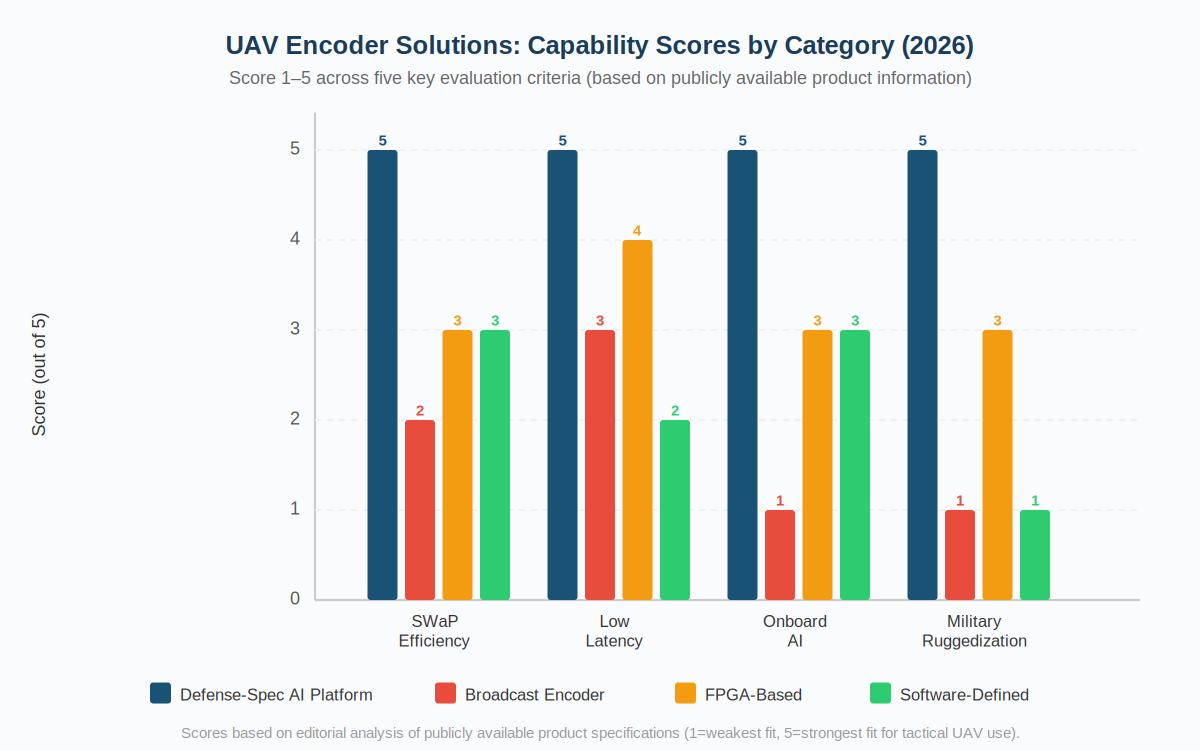

| Criteria | Maris-Tech (Jupiter / UAV Encoders) | Broadcast-Derived Pro Encoders | FPGA-Based Configurable HW | Software-Defined Stacks |
| SWaP Optimization | High — purpose-built for UAV payload budgets | Low — designed for fixed/ground installations | Medium — configurable but often larger than needed | Medium — depends on host compute platform |
| End-to-End Latency | Ultra-low (<80 ms target) | Moderate (100–300 ms typical) | Low–Medium (varies by configuration) | Variable (often >150 ms on modest hardware) |
| H.265 / HEVC Encoding | Hardware-accelerated, standard | Supported, often hardware | Configurable; hardware H.265 available | Software H.265; hardware depends on GPU |
| Onboard AI Capability | Integrated (edge AI acceleration) | Not available | Requires custom IP core development | Depends on host platform GPU |
| Multi-Stream Support | Yes, multi-channel simultaneous | Limited; typically single-channel | Configurable with additional FPGA resources | Depends on CPU/GPU resources |
| Military Ruggedization | Yes — MIL-STD environments | No — commercial grade | Varies — some industrial-grade options | No — inherits host platform rating |
| Defense Customer Validation | Yes — governmental and defense customers | No specific defense validation | Used in some defense-adjacent programs | Limited; primarily commercial applications |
Source: Publicly available product specifications and company websites.
Defense-Specialized UAV Encoders: The Case for Purpose-Built Hardware
Defense and security procurement managers consistently find that broadcast-derived or commercial encoders require significant modification — or are simply unsuitable — for UAV integration. The gap is most acute in three areas: SWaP, latency under electronic warfare conditions, and onboard AI.
Specialized tech providers address all three directly through dedicated uav encoder product lines, which have been specifically engineered for the UAV environment. High-performance drone encoder platforms are designed to withstand vibration, temperature extremes, and RF interference common in UAV operations — constraints that commercial video hardware does not account for. Systems requiring high physical flexibility deploy miniature uav encoders to comfortably fit specialized layouts while maintaining multi-stream drone encoder pipelines intact.
FPGA-Based Solutions: Flexibility vs. Integration Complexity
Field-programmable gate array (FPGA) based encoder solutions offer configurability advantages — a program can, in theory, update the encoder’s processing pipeline to accommodate new codecs or AI models via firmware. In practice, however, FPGA development requires specialized engineering expertise and extended development timelines. For programs with defined requirements and tight delivery schedules, an integrated, validated solution typically offers a lower total integration cost than a flexible but complex FPGA platform.
Software-Defined Encoding: When It Works and When It Doesn’t
Software-defined encoding on embedded compute platforms (ARM SoCs, Nvidia Jetson, etc.) has become more capable as chip performance has increased. For commercial inspection or mapping drones where latency targets are relaxed (under 300 ms is typically acceptable), software stacks offer integration flexibility. For tactical defense applications requiring sub-100 ms latency, dedicated hardware encoding is still necessary — software encoding on embedded platforms introduces encode latency of 50–150 ms before transmission even begins.
Scoring Summary
| Category | Defense-Spec Hardware | Broadcast Pro | FPGA-Based | Software-Defined |
| Tactical UAV Suitability | ★★★★★ | ★★☆☆☆ | ★★★☆☆ | ★★☆☆☆ |
| Commercial/Inspection UAV | ★★★★☆ | ★★★☆☆ | ★★★☆☆ | ★★★★☆ |
| Integration Simplicity | ★★★★☆ | ★★★★☆ | ★★☆☆☆ | ★★★☆☆ |
| Onboard AI Readiness | ★★★★★ | ★☆☆☆☆ | ★★★☆☆ | ★★★☆☆ |
| SWaP Efficiency | ★★★★★ | ★★☆☆☆ | ★★★☆☆ | ★★★☆☆ |
Note: Ratings are editorial assessments based on publicly available product information. ★★★★★ = strongest fit for category.
Conclusion: Which UAV Encoder Is Right for Your Application?
For tactical defense and security applications where SWaP, latency, onboard AI, and military ruggedization are all required simultaneously, purpose-built defense-specialized platforms have a clear structural advantage over broadcast, FPGA, or software alternatives. High-grade architectures combine multi-channel hd video encoder systems alongside ai embedded systems to aggregate, analyze, and encode incoming sensor data right at the edge.
Broadcast-derived encoders remain the better choice for studio and event production. FPGA solutions suit programs with extended development timelines and highly customized processing requirements. Software-defined stacks work well for commercial drones with relaxed latency targets. Understanding this segmentation is the first step to making the right procurement decision.
For competitive product information, readers may also refer to Teradek’s UAV encoder offerings as a reference point for broadcast-heritage solutions in this market.