Tech
The Best Broadcasting Equipment for Live Video Broadcasting in 2025: A Professional Buyer’s Guide


Introduction
Investing in professional broadcasting equipment is one of the most significant capital decisions a production company or broadcaster can make. The wrong choice results in equipment that underperforms in field conditions, lacks the connectivity options required for modern live video broadcasting, or becomes obsolete before it has been amortized. This guide provides a practical framework for evaluating professional encoder solutions, with a focus on the specifications that actually matter in the field.
Defining Your Live Video Broadcasting Requirements
Before evaluating hardware, production teams need clarity on four key variables: the resolution and frame rate requirements of the output (HD, 4K, HDR), the network environments in which the equipment will be deployed (studio, outdoor, remote/international), the scale of the operation (single-camera vs multi-camera, single-event vs ongoing coverage), and the integration requirements with existing production infrastructure.
These variables map directly onto hardware tiers. A two-person news crew covering a press conference in a hotel conference room has fundamentally different requirements from a host broadcaster deploying 40 simultaneous live feeds at an Olympic venue.
Key Specifications to Evaluate
When comparing broadcasting equipment, the following specifications are the most consequential for field production performance:
- Modem count and carrier support: more modems mean more path diversity and higher aggregate bandwidth ceiling
- 5G capability: look for Sub-6 GHz and mmWave support to future-proof investment as 5G networks mature
- Encoding format: HEVC (H.265) is now the minimum standard for bandwidth efficiency; AV1 support is emerging for OTT-focused workflows
- Latency profile: critical for live sports and breaking news; target sub-500ms for professional contribution
- Return feed capability: essential for reporter IFB and remote production (REMI) workflows
- Management platform: remote monitoring and control capability significantly reduces the operational headcount required for multi-unit deployments
The LiveU LU900Q: Top-Tier Live Video Broadcasting
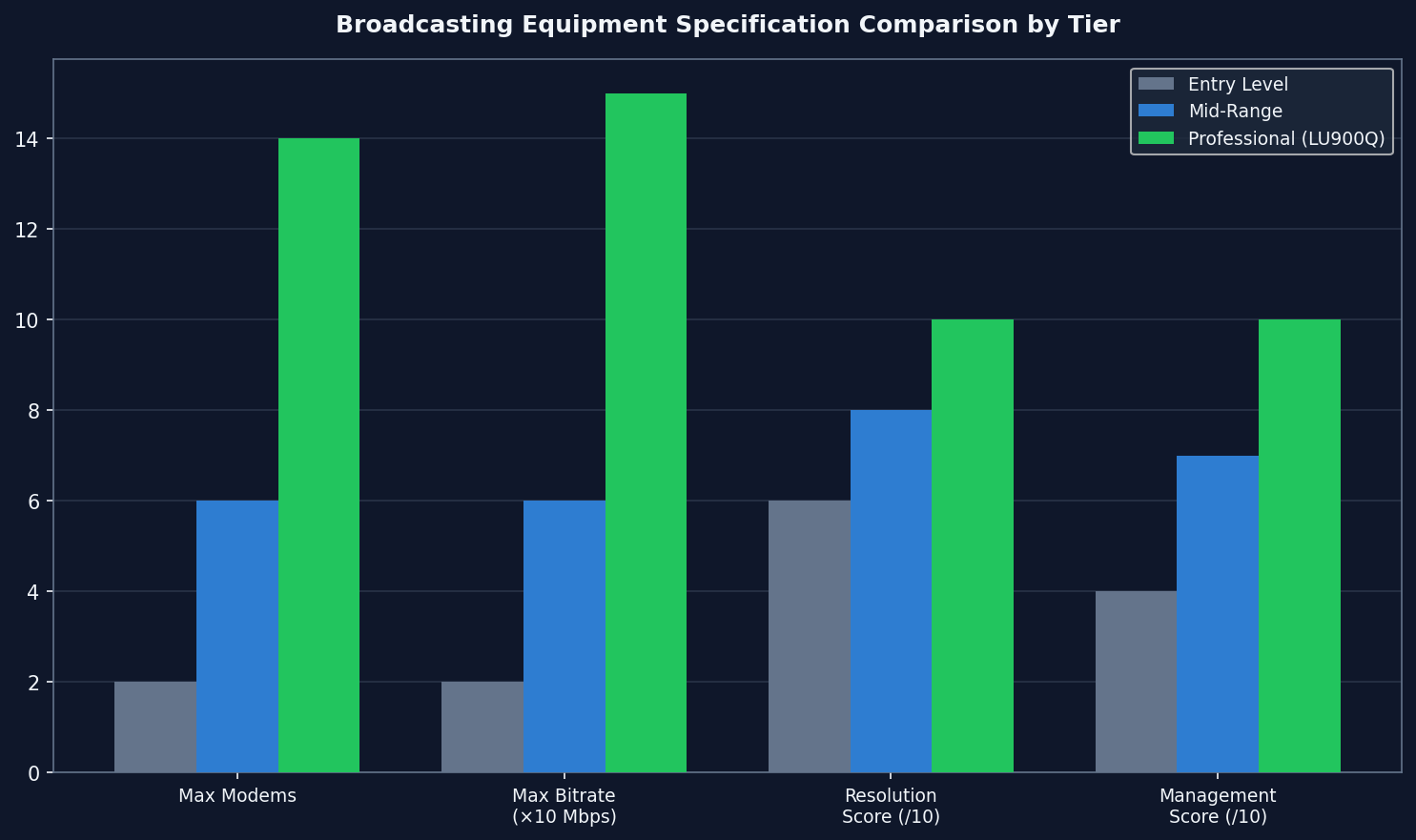
At the professional tier, the LiveU LU900Q is the benchmark solution for demanding live video broadcasting applications. Its 14-modem bonding architecture, combined with 5G NR support and HEVC encoding up to 4K, delivers the aggregate bandwidth and reliability profile required for tier-1 sports, news, and entertainment coverage.
The LU900Q integrates fully with LiveU Central, the company’s cloud-based management platform. For organizations managing multiple units across multiple simultaneous live productions, Central provides the visibility and control to manage encoder settings, monitor signal quality, and troubleshoot issues without dispatching on-site technical staff – a capability that fundamentally changes the economics of large-scale live production.
Mid-Range Broadcasting Equipment: Balancing Cost and Capability
Not every production requires flagship-level hardware. For single-camera ENG crews, documentary teams, and smaller sports rights holders, mid-range encoder units offer a compelling balance of capability and cost. The key requirements at this tier are: at least four bonded modems, HEVC encoding to HD or 1080p, and solid remote management support.
LiveU’s product range spans from compact units designed for smartphone integration to the professional-grade LU900Q, providing broadcasters with a clear upgrade path as their production scale grows. The lineup blog provides a detailed comparison across the full range, helping teams identify the most appropriate unit for their specific workflows.
Total Cost of Ownership in Live Broadcasting
The purchase price of broadcasting equipment is only part of the total cost picture. Operational costs – satellite time, SIM data plans, technical staffing, transportation – often exceed hardware costs over a multi-year deployment lifecycle. IP-bonded cellular solutions typically offer significant operational cost savings versus satellite-based alternatives, particularly for productions in covered territories where cellular infrastructure is reliable.
For organizations comparing IP bonded cellular against satellite, it is worth modeling the TCO over 36 months. Factor in the cost per event of satellite bandwidth, the weight and freight costs of large flyaway kits, and the staffing requirements for satellite operations versus cellular-based deployment.
Conclusion
The right broadcasting equipment is the foundation of reliable live video broadcasting. As 5G networks mature and IP contribution workflows become universal, the performance gap between cellular-based encoders and legacy satellite systems will continue to close. For production teams evaluating their next equipment investment, clarity on use-case requirements, combined with an understanding of the total cost of ownership, is the starting point for making the right choice.