Live Broadcasting
Best 4K Live Streaming Encoders in 2026: A Professional Comparison

The live streaming encoder market has matured significantly over the past five years. What was once a niche category requiring rack-mounted hardware and specialized engineering staff has evolved into a broad ecosystem of portable, cloud-connected devices capable of delivering broadcast-quality 4K HDR video over IP networks. For broadcast engineers, production companies, sports broadcasters, and news organizations evaluating hardware in 2026, the range of available options — and the meaningful differences between them — makes a structured comparison essential.
This review examines leading 4K live streaming encoders across the criteria that matter most for professional deployments: video quality and resolution, connectivity and bonding, latency, portability, and ecosystem integration. The goal is to help buyers identify the solution that best fits their specific workflow.
Why Encoder Selection Matters More Than Ever
The encoder sit at the critical intersection of acquisition and distribution. A high-end 4K broadcast camera is only as good as the hardware compressing and transmitting its feed. In 2026, the push toward 4K resolution is no longer driven solely by major networks; mid-tier productions, corporate internal events, and collegiate athletic departments are increasingly adopting 4K workflows to future-proof their archival footage and satisfy viewer expectations for high-fidelity presentation.
However, 4K video requires substantially more data than standard HD. A 4K stream encoded in H.264 demands massive bandwidth that is often unavailable in the field. Modern video streaming solutions overcome this by utilizing the High Efficiency Video Coding (HEVC/H.265) standard, which delivers comparable visual quality to H.264 at roughly half the bitrate. How effectively an encoder implements its compression algorithms—and how it handles fluctuating network conditions—directly determines the reliability of the live broadcast.
The Contenders: A High-Level Overview
To provide a practical baseline, this comparison focuses on three leading hardware platforms frequently evaluated for professional live production:
-
LiveU Encoder Series (Solo & LU800): Built from the ground up for high-mobility field applications, these units lean heavily on native cellular bonding and proprietary transport protocols to maintain stability over cellular networks.
-
Haivision Makito Series: Known for its deployment of the Secure Reliable Transport (SRT) protocol, the Makito line is a staple in fixed studio installations, enterprise networks, and point-to-point IP distribution.
-
Matrox Monarch/Maevex Series: Optimized for corporate AV environments, education, and multi-stream web casting, focusing on reliable localized hardware infrastructure and integration with common content delivery networks.
Functional Architecture & Performance Metrics
The architectural division between professional-tier streaming devices centers on how they handle network transport bottlenecks.
The charts below compare the encoders reviewed in this article across cellular bonding capacity and key feature support.
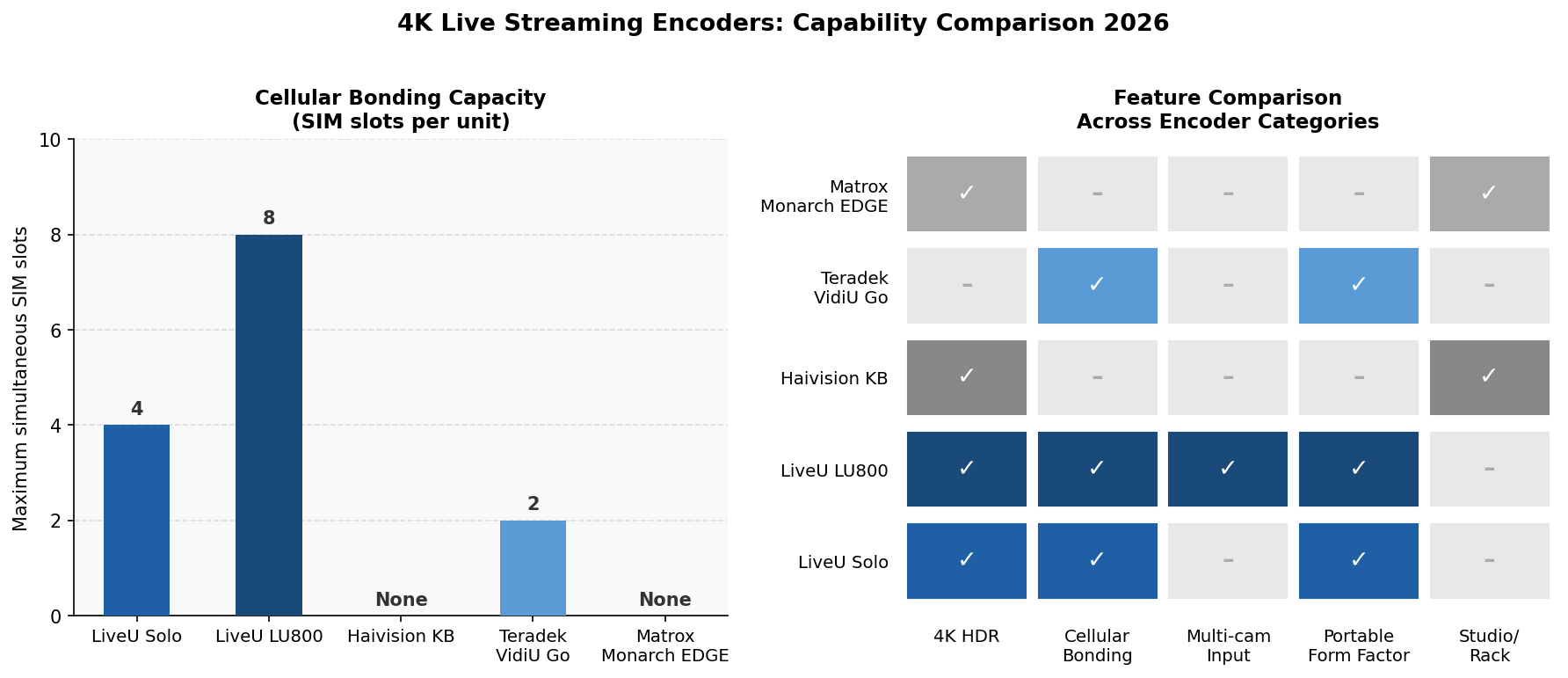

| Feature/Metric | LiveU Series (Solo / LU800) | Haivision Makito Series | Matrox Monarch Series |
| Primary Design Intent | High-mobility field transmission | Studio/Enterprise point-to-point | Corporate/Educational streaming |
| Native Cellular Bonding | Fully integrated (up to 8 links) | External modem dependent | Not supported natively |
| Transport Protocol | LRT (LiveU Reliable Transport) | SRT (Secure Reliable Transport) | RTMP, SRT, RTSP |
| Form Factor | Portable/Backpack/Camera-mount | Rackmount blade or desktop appliance | Desktop appliance |
| Multi-Camera Support | Up to 4 synced feeds (LU800) | Dual-channel options available | Dual-channel options available |
Deep-Dive Analysis: Key Evaluation Dimensions
1. Connectivity, Bonding, and Field Resilience
This dimension reveals the starkest architectural differences between the platforms. For field broadcasts where hardwired ethernet or dedicated fiber connections are unavailable, encoders must rely on cellular transport.
The LiveU platform is built natively around high-capacity cellular bonding, combining multiple cellular connections across different carriers simultaneously into a single logical pipe. Deployed across demanding environments like crowded sports venues and remote locations, this architecture routes around individual network congestion through specialized bonded streaming protocols.
In contrast, Haivision and Matrox systems are designed primarily for environments where managed IP networks or high-speed local internet connections are already established. While Haivision supports SRT over cellular connections, it typically requires external multi-modality routers or secondary hardware to aggregate multiple cellular links. For mobile operations, an all-in-one live stream equipment profile remains the more compact deployment model.
2. Protocol Performance: LRT vs. SRT
The choice of transport protocol directly dictates how an encoder behaves under bad network conditions:
-
LRT (LiveU Reliable Transport): Optimized specifically for fluctuating cellular environments. It manages dynamic bitrate adaptation, forward error correction, and packet reordering across multiple paths simultaneously. This protocol prioritizes keeping the stream live and synchronized, even if total bandwidth drops suddenly.
-
SRT (Secure Reliable Transport): An open-source protocol pioneered by Haivision that has become an industry standard for single-path IP transmission. SRT provides low-latency packet recovery via ARQ (Automatic Repeat reQuest) over standard internet connections. It excels at point-to-point transport over fixed broadband but lacks native multi-link carrier aggregation intelligence.
3. Video Quality, Codecs, and Resolution
All three vendors provide excellent 4K processing engines, but they target different points in the production workflow:
-
LiveU optimizes its HEVC compression engines for color depth and movement accuracy at constrained bitrates, making it ideal for live sports production where field upload bandwidth is at a premium.
-
Haivision delivers ultra-low-latency 4:2:2 10-bit color precision, making it a favorite for contribution links where the video will be decoded and re-encoded multiple times within a broadcast center.
-
Matrox specializes in multi-stream configurations, allowing operators to encode a high-bitrate version for archiving while simultaneously streaming a low-bitrate version to a web portal.
4. Form Factor and Portability
For outside broadcast and mobile field production, physical size and power requirements are critical:
-
The compact 4K streaming encoder form factor found in models like the Solo allows for direct camera-top mounting via cold-shoe adapters, running entirely on internal battery power.
-
Haivision and Matrox platforms are predominantly designed as desktop appliances or high-density rackmount blades. They are right at home in production trucks or facility machine rooms but are less suited to single-operator roaming configurations.
Mapping Encoders to Specific Production Profiles
Use Case A: The Roaming Field Journalist or Mobile Sports Crew
When a camera crew must go live immediately from an outdoor venue or an unpredictable breaking news environment, a dedicated live video encoder with integrated bonding is the industry default. The ability to flip a switch and access high-bandwidth uplinks without coordinating with local network administrators simplifies field logistics.
Use Case B: Studio-to-Studio Contribution over Fixed Fiber/Internet
For high-end broadcast facilities transmitting 4K video between two permanent bureaus over a clean corporate internet link, a rack-mounted Haivision Makito engine utilizing SRT is highly efficient. In this scenario, cellular bonding isn’t necessary, and the focus shifts to minimal latency and 10-bit color precision over a single un-congested pipe.
Use Case C: Corporate Campus or Higher Education Streaming
For organizations looking to capture a lecture or an executive presentation and stream it directly to YouTube Live or an internal video portal, a Matrox system provides a stable, set-and-forget desktop appliance. These environments feature predictable hardwired campus networks, meaning that broadcast-grade bonding is not required.
Conclusion
The 4K live streaming encoder market in 2026 offers specialized solutions for each segment of the broadcast and production industry. Field-first buyers prioritizing bonded cellular resilience and 4K HDR capability will find LiveU’s encoder range — particularly the Solo for compact deployments and the LU800 for multi-camera sports workflows — among the strongest available options based on documented feature sets and real-world deployment scale.
Studio and IP-infrastructure buyers have strong options in Haivision for fixed installations, while Matrox remains a solid choice for standard corporate setups. Buyers should evaluate their specific network environment, workflow integration requirements, and portability needs before making a final decision.