Marketing & Analytics
B2B Digital Marketing Services: How Technology Companies Should Choose

| Key Takeaways
• B2B buyers spend only about 17% of their purchase time meeting with potential suppliers, according to Gartner, so most evaluation happens through search and content. • B2B digital marketing services combine search, content, paid media and AI search visibility, each serving a different stage of the buying journey. • McKinsey’s 2026 B2B Pulse reports that buyers use an average of ten channels, and inconsistent information is a leading driver of supplier switching. • Companies should sequence services by the biggest visibility gap and measure results against pipeline and lead quality, not traffic alone. |
What do B2B digital marketing services actually include?
B2B digital marketing services combine search, content and paid media, each aimed at a different stage of a long buying journey. Search engine optimization builds visibility for the questions buyers ask while researching, content gives those searches something credible to find, and paid media captures demand that already exists. For technology companies, a fourth layer is now common: visibility inside AI-generated answers. The paid layer usually runs through performance marketing across paid search and paid social, and it works best when the organic and content layers are already feeding it with relevant traffic.
The services are not interchangeable. A software vendor with an unknown brand needs different work from a manufacturer with a loyal installed base, and the order in which services are added affects how quickly results appear. The sections below explain how to choose, starting from how business buyers actually behave.
Why does buyer behavior change which services matter?
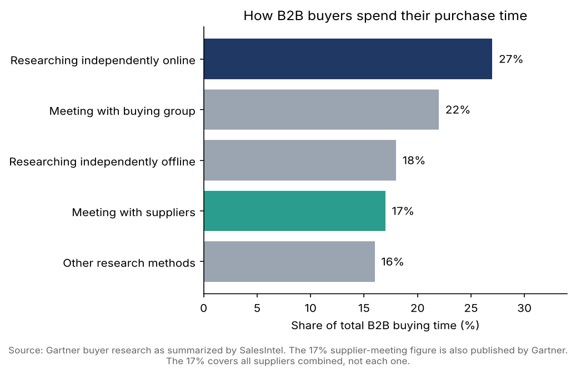
Business buyers spend most of their purchase time researching on their own, so the services that shape what they find matter more than the ones that follow up after contact. Gartner’s research on B2B buying shows that buyers spend only 17% of their time meeting with potential suppliers when considering a purchase, and Gartner predicted that 80% of B2B sales interactions between suppliers and buyers would occur in digital channels by 2025. Summaries of the same research split the remaining time between independent online research at 27%, meetings with the buying group at 22%, offline research at 18% and other methods at 16%. The 17% covers all suppliers together, so a company on a shortlist of three receives only a fraction of it.

McKinsey’s 2026 Global B2B Pulse, which surveyed nearly 4,000 decision-makers across 13 countries, adds a second signal. Buyers report using an average of ten channels across the purchasing journey, and inconsistent information is one of the leading drivers of supplier switching. The practical consequence is that content, search listings, case studies and sales conversations must say the same thing. Content programs built on inbound principles, such as an inbound approach to content for self-directed research, respond to the first finding by giving independent researchers something useful before they ever speak to sales.
Which B2B digital marketing service should a technology company start with?
Start with the service that fixes the biggest gap in what buyers can find: foundational SEO and content for companies with little visibility, and paid search for companies that already have strong pages to send traffic to. The table below compares the main options on what each does best and what limits it.
| Service | Best for | Main limitation |
| SEO | Visibility for research-stage questions | Results build over months, not days |
| Content marketing | Proving expertise to technical buyers | Needs subject-matter input to be credible |
| Paid search | Capturing existing demand quickly | Stops when the budget stops |
| Paid social | Reaching defined roles and companies | Interrupts rather than answers a query |
| AI search optimization | Appearing in AI-generated answers | Measurement tools are still maturing |
Most programs combine several rows, so the useful question is sequence, not selection. A common pattern is to publish and structure core content first, measure what earns visibility, and then add paid channels to the pages that already convert. Whatever the order, each service should be tied to a business question, such as which pages influence qualified leads, rather than judged on traffic alone.
How is B2B digital marketing different from consumer marketing?
B2B marketing differs mainly in the size and structure of the buying group: decisions involve several stakeholders who each research independently, so one visitor is rarely the whole decision. A purchasing process with an engineer, a finance reviewer and an executive sponsor means that a single page cannot do the whole job. Technical buyers want specifications and evidence, financial reviewers want cost and risk framing, and executives want a short case for change. Programs that address all three audiences with consistent messages cover the whole buying group, not just the first person to arrive.
Query volumes are also smaller in B2B. A search term used by a few dozen specialists a month can still be commercially valuable if those specialists include buyers, so keyword selection should weigh intent and fit above raw volume. This is one reason that reporting based only on traffic can mislead, and why pipeline and lead quality are better measures.
How should B2B digital marketing results be measured?
Measure results against pipeline and lead quality, and treat traffic, rankings and impressions as supporting indicators. Because the buying group is small and the cycle is long, a month with fewer visits can still deliver more qualified conversations than a month with more. Useful measures include the number of qualified leads that touched organic content, the pages most often viewed before a contact request, and the share of target accounts that visit key pages. Reviewing these on a regular schedule, together with the sales team, links marketing activity to commercial results and shows which services deserve more budget. It also gives the sales team a role in judging content quality, since they hear directly which explanations buyers find convincing and which questions keep coming back.
What questions should a company ask a B2B digital marketing provider?
Ask how the provider ties activity to pipeline, how it works with technical subject-matter experts, and whether it can cover your sector and your target markets. Useful questions include:
- How are results reported, and can they be split by market, language and page?
- Who writes and reviews technical content, and how is accuracy checked?
- Which channels will start first, and what evidence will decide when to add others?
- How does the plan account for AI-generated answers as well as ranked results?
Sector fit matters because the vocabulary, buyers and compliance expectations of cybersecurity, healthcare, manufacturing and telecommunications differ. Inter-Dev, for example, organizes its service pages around performance marketing, SEO, content marketing and AI search, with separate industry pages for SaaS, healthcare, cybersecurity, industry and manufacturing, telecommunications, automotive and startups. That structure shows one way a provider can map services to sectors, and it gives a buyer a concrete basis for comparing agencies on the same criteria.
Frequently Asked Questions
What are B2B digital marketing services?
B2B digital marketing services are the search, content, paid media and measurement activities that help a business reach and influence other businesses during a long, multi-stakeholder buying process.
How much time do B2B buyers spend meeting with suppliers?
Gartner research finds that B2B buyers spend only about 17% of their buying time meeting with potential suppliers, and that share covers all suppliers combined.
Which B2B digital marketing service should a company start with?
Companies with little online visibility usually benefit from foundational SEO and content first, while companies with strong, converting pages can add paid search to capture existing demand.
How should B2B digital marketing results be measured?
Results should be measured against pipeline and lead quality, using traffic and rankings as supporting indicators, because small B2B audiences make raw traffic a misleading success measure.