Marketing & Analytics
Why Optimizing for One AI Engine Leaves B2B Brands Invisible to the Rest



| Key Takeaways
• ChatGPT’s share of B2B AI referral traffic fell from 89.1% to 62.6% in eight months, while Claude, Gemini, and Perplexity each gained meaningful share over the same period. • Claude and Perplexity send a disproportionately large share of referrals relative to their smaller user bases, consistent with both platforms skewing toward research-stage queries. • Generative Engine Optimization rewards structural clarity and self-contained factual statements, while traditional SEO rewards keyword matching and backlink volume. • B2B AI referral share shifted by double-digit percentage points within a single year, meaning single-engine optimization strategies can lose relevance quickly. |
Why do B2B buyers now split their research across several AI engines?
B2B buyers no longer settle on one AI assistant for vendor research; they move between ChatGPT, Claude, Gemini, and Perplexity depending on the task, and each engine now carries a meaningful share of B2B referral traffic. A recent longitudinal study of B2B referral sessions across a 41-brand panel found that ChatGPT’s share of that traffic fell from 89.1% to 62.6% in eight months, while Claude’s share rose from 1.4% to 18.5%, Gemini’s from 2.4% to 10.6%, and Perplexity’s from 3.1% to 7.3%. A brand optimizing for a single engine is now missing more than a third of the B2B AI referral landscape it would have covered a year earlier.
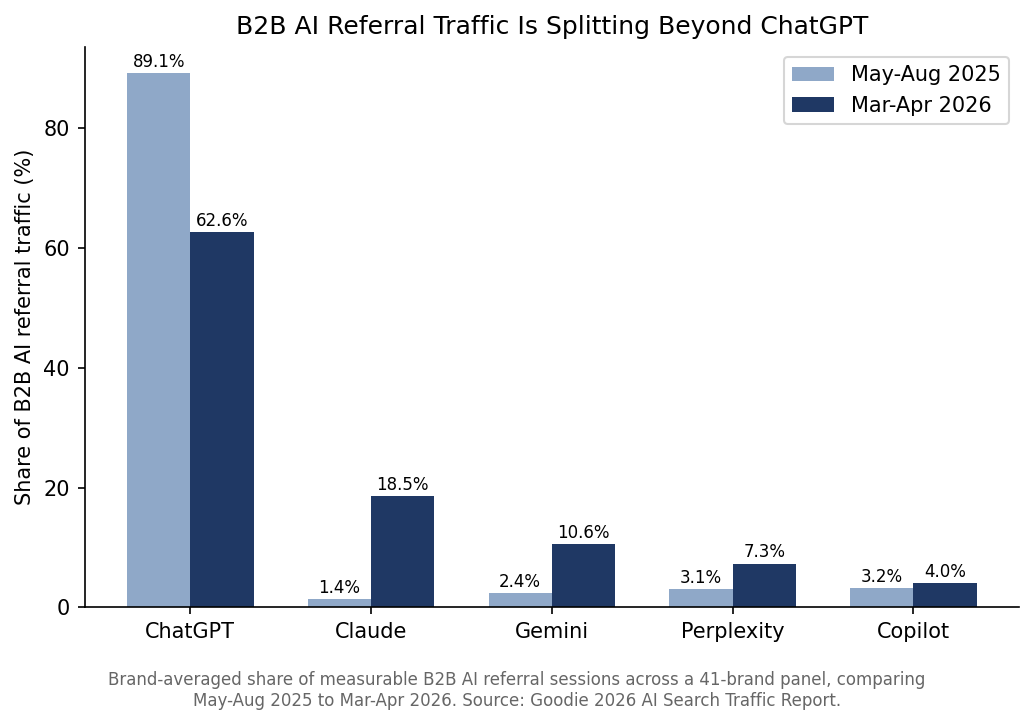

B2B AI referral traffic share by engine, comparing May-Aug 2025 to Mar-Apr 2026. Source: Goodie 2026 AI Search Traffic Report.
Do different AI engines behave the same way when they cite a source?
No. Each engine runs its own retrieval pipeline, weighs different signals, and serves a different point in the buyer’s research process, so content that earns a citation on one engine does not automatically earn one on another. ChatGPT’s referral behavior tracks closely with its overall usage volume, while Claude and Perplexity send a disproportionate share of referrals relative to their smaller user bases, consistent with both platforms skewing toward research-stage, source-checking queries rather than casual browsing. Gemini behaves as two distinct surfaces at once, a standalone conversational assistant and the model powering Google’s own AI Overviews and AI Mode inside search results, and the two surfaces send referral traffic at very different rates because one is built for open-ended conversation and the other is built to answer a query without the user leaving the results page. a deeper breakdown of engine-specific optimization priorities lays out how ChatGPT, Gemini, Perplexity, and Claude differ in the audiences and query types they attract.
What happens to a brand that only optimizes for the most popular engine?
A brand that optimizes only for the currently dominant engine builds visibility that erodes as fast as that engine’s market share does, and the last eight months show how quickly that share can move. Treating GEO as a single-engine project mirrors the mistake B2B marketers made when they treated SEO as a single-search-engine project; the fix is the same in principle: build content and technical infrastructure that generalizes across retrieval systems rather than gaming one algorithm. the practice’s overview of what AI search optimization actually requires walks through the foundational risks B2B brands face when their content isn’t structured for AI interpretation in the first place.
How is Generative Engine Optimization different from traditional SEO?
Generative Engine Optimization (GEO) optimizes for being the source an AI model trusts enough to cite and synthesize into its answer, while traditional SEO optimizes for ranking in a list of links a human then chooses from. The practical difference shows up in what gets rewarded: SEO rewards keyword matching and backlink volume, while GEO rewards structural clarity, topical depth, and the kind of self-contained factual statements a model can lift directly into a generated answer. a full comparison of the two disciplines and how the shift changes a content roadmap walks through the practical differences in more detail.
Should a B2B marketing team build separate content for each AI engine?
Not separate content, but a single content and technical foundation built to generalize: clear entity definitions, direct answers near the top of a page, and a presence on the third-party sites each engine treats as trust signals. The engines differ in retrieval mechanics, but they converge on rewarding the same underlying qualities: content that states facts plainly, cites its own sources, and appears consistently across multiple independent domains rather than only on the brand’s own site. A page written to answer one specific question clearly, with the direct answer stated in the opening sentences, tends to perform well across every major engine because that structure matches how each of them extracts and summarizes source material, regardless of the underlying retrieval mechanism.
What does a multi-engine measurement approach actually look like in practice?
A multi-engine measurement approach tracks citation frequency, referral traffic, and share of voice separately for each major engine rather than collapsing them into a single generic AI-traffic metric. Standard analytics platforms undercount this activity in two structural ways: native AI apps frequently strip referrer data so AI-originated visits land in a generic direct-traffic bucket, and Google does not separately attribute its own AI Overviews and AI Mode surfaces, bundling them into ordinary organic search reporting. A marketing team relying solely on referrer logs will systematically understate its actual AI visibility, sometimes by a wide margin, which makes engine-specific monitoring tools a practical necessity rather than a nice-to-have for any B2B brand serious about this channel.
Why does engagement quality matter as much as raw traffic volume from AI sources?
AI-referred traffic tends to engage more deeply than traffic from most traditional channels, spending more time on a page and completing more of the intended action once it arrives, which changes how a marketing team should value a smaller volume of AI-driven visits. A buyer who reaches a vendor’s site after an AI assistant has already synthesized several competing options into a shortlist arrives with more context and higher intent than a buyer clicking through ten generic search results, so the same absolute traffic number carries different pipeline value depending on where it originated. This is part of why treating AI visibility purely as a volume metric understates its importance: the quality of the visit, not just the count, is what should drive investment decisions across engines.
What is the practical first step for a B2B team that has only optimized for one engine so far?
The first step is an honest audit of current visibility across all four major engines rather than assuming that success on one engine implies success on the others, since the underlying retrieval logic differs enough that visibility does not transfer automatically. From there, prioritize the technical and structural fixes, such as clear entity definitions and direct, quotable answers near the top of key pages, that tend to generalize across engines before investing in engine-specific tactics that may not survive the next shift in market share. Given how quickly the distribution moved over the past year, building for resilience across engines is a more defensible long-term strategy than optimizing narrowly for whichever engine currently holds the largest share.
Frequently Asked Questions
Is ChatGPT still the most important AI engine for B2B visibility?
It remains the largest single source of B2B AI referral traffic, but its share has fallen from roughly 89% to 63% in under a year as Claude, Gemini, and Perplexity have grown, so it is no longer the only engine that matters.
Why does Claude send a larger share of referrals than its user base would suggest?
Claude’s usage skews toward research-stage and technical queries, and platforms with that usage pattern tend to convert a larger share of sessions into outbound clicks to source material than platforms used mainly for casual browsing.
Does optimizing for AI engines replace the need for traditional SEO?
No, traditional SEO and Generative Engine Optimization address different discovery paths and both remain relevant, since a meaningful share of buyer research still happens through conventional search results pages.
How quickly can a B2B brand’s AI engine visibility change?
Very quickly. Aggregate B2B referral share across major AI engines shifted by double-digit percentage points within a single year, so brands need to track visibility across engines rather than assuming today’s distribution will hold.