Migration solutions
Aliyah and Real Estate: Where New Immigrants Are Buying in Israel – and Why

Introduction
The decision to make Aliyah – to immigrate to Israel – is one of the most profound choices a Jewish person can make. It is also one that comes with an immediate, pressing practical question: where do you live? And more specifically: do you rent first, or do you buy? The Israeli housing market has its own rhythms, its own legal structures, and its own community dynamics that can make navigating it overwhelming for new arrivals. Yet for those who approach it with the right information and the right support, it can also represent one of the most significant financial decisions of their lives. Home in Israel works with Olim (new immigrants) and pre-Aliyah families to make the housing process as clear and as well-timed as possible – providing guidance that is sensitive to both the practical and emotional dimensions of this transition.

Aliyah Trends: Who Is Making the Move in 2025?
Aliyah rates have surged in the 2020s, driven by a combination of push factors (rising antisemitism in diaspora countries, political instability, and economic uncertainty) and pull factors (Israel’s strong economy, community connections, and the universal right of Jewish immigration).
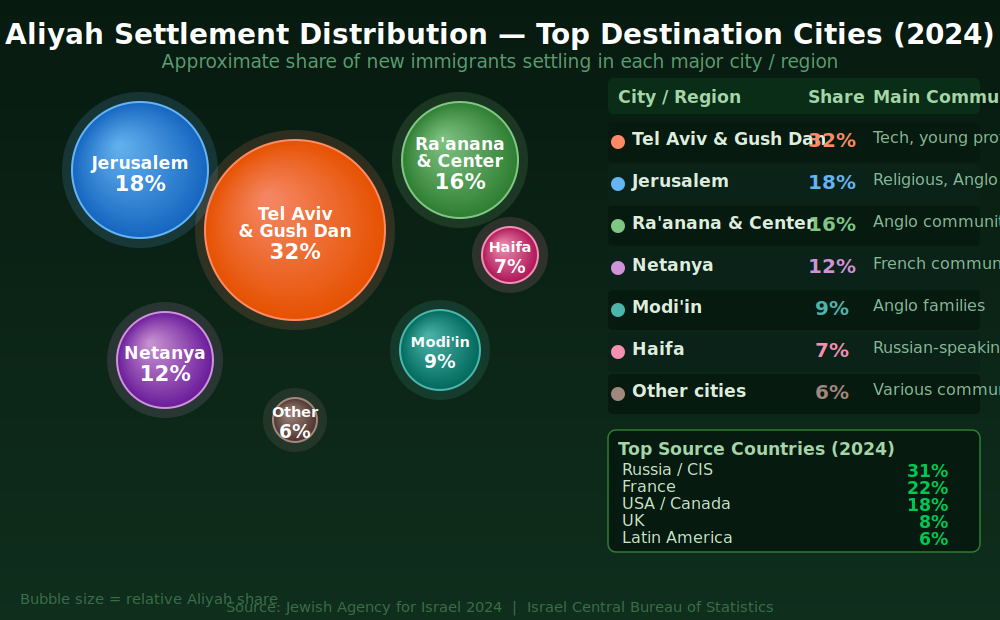
According to data from the Jewish Agency for Israel, more than 40,000 new immigrants arrived in Israel in 2023 alone, with the pace continuing into 2024-2025. The source countries have shifted considerably:
- France: Historically the largest single source of Western Aliyah, with over 200,000 French Jews having made Aliyah since 2000
- United States and Canada: Growing rapidly, particularly post-pandemic, with Anglo Olim often bringing significant financial resources
- United Kingdom: Steady stream, with strong community networks in specific Israeli cities facilitating settlement
- Argentina and Latin America: Economic drivers remain powerful, with Spanish-speaking communities concentrated in specific Israeli cities
- Russia and Former Soviet states: Major wave post-2022, with significant numbers settling in central Israel and the north
The Oleh Purchase Tax Benefit: A Critical Financial Advantage
One of the most significant financial benefits available to new immigrants is the Oleh purchase tax reduction. Unlike standard foreign buyers – who pay 8% purchase tax from the first shekel – new Olim who purchase within their first seven years of Aliyah receive a dramatically reduced rate. Understanding and correctly applying this benefit is a key part of the planning process. Expert guidance for Aliyah home buyers covers the full scope of benefits available to new Olim and how to time purchases to maximize them.
| Buyer Status | Purchase Tax (on NIS 3M property) | Potential Saving vs. Foreign Buyer |
| Israeli resident – first home | ~NIS 0-12,000 (low bracket benefit) | ~NIS 228,000 |
| New Oleh (within 7 years) | ~NIS 15,000 (reduced Oleh rate) | ~NIS 225,000 |
| Foreign buyer (non-resident, non-Oleh) | ~NIS 240,000 (8% rate) | Baseline |
Note: Purchase tax calculations are approximate. Rates and brackets change periodically. Always verify with a qualified Israeli attorney.
Where Are Olim Buying? City-by-City Breakdown
Community, language, lifestyle, and budget all influence where new immigrants settle. Here is how the main Aliyah destination cities compare:
- Ra’anana: The Anglo Aliyah capital of Israel. A large English-speaking community, excellent schools, and a suburban lifestyle with good transport links to Tel Aviv. Property prices: NIS 3M-NIS 8M
- Netanya: Strongly identified with French Aliyah, with French-language schools, shops, and social infrastructure. A Mediterranean coastal city with a more relaxed pace. Property prices: NIS 1.8M-NIS 5M
- Jerusalem: Deep resonance for Olim with a religious or Zionist identity. Significant Anglo and French communities in specific neighborhoods. Property prices: NIS 1.5M-NIS 25M+
- Tel Aviv and the Gush Dan: For younger Olim, particularly those entering Israel’s tech sector. Dynamic, secular, and cosmopolitan. Property prices: NIS 2.5M+ for central apartments
- Modi’in: A planned city between Tel Aviv and Jerusalem, popular with Anglo families. Modern infrastructure and a strong community feel at more accessible prices. Property prices: NIS 2M-NIS 5M
- Haifa: The most affordable major city in Israel, with a strong academic and tech community. Growing in popularity, particularly among Russian-speaking Olim. Property prices: NIS 1.2M-NIS 4M
Rent First or Buy Immediately? The Aliyah Housing Dilemma
- Financial readiness: Buying requires liquid capital for purchase tax, legal fees, and deposit. Many families arrive with significant resources; others need time to liquidate assets in their country of origin
- Community certainty: Some Olim know exactly where they want to live before they arrive. Others need six to twelve months of living in Israel to discover which city truly fits their family
- The Oleh tax window: The reduced purchase tax benefit is available for seven years post-Aliyah. This creates flexibility – there is no urgency to buy immediately to preserve the benefit
- Market timing: Israel’s property market has historically trended upward over the medium-to-long term. Renting while the market continues to appreciate carries its own opportunity cost
- Israeli mortgage access: New Olim with Israeli employment income can access Israeli mortgages, often improving their purchasing power compared to purchasing as a foreign national
The Practical Timeline: Pre-Aliyah to Purchase
- 12-18 months pre-Aliyah: Begin researching cities and neighborhoods. Use remote visits, community groups, and specialist agencies to build a clear picture
- 6-12 months pre-Aliyah: Establish Israeli bank account, begin conversations with Israeli mortgage brokers, identify preferred neighborhoods
- Month 1-3 post-Aliyah: Settle, explore, confirm community fit. Rent in the target area to test the neighborhood before committing
- Month 3-12 post-Aliyah: Active property search. Engage a local agency, arrange viewings, commission due diligence
- Purchase completion: Sign contracts, pay purchase tax at Oleh rate, register in Tabu
Conclusion
The Aliyah housing journey is one of the most meaningful transitions a family will navigate. The Oleh purchase tax benefit alone can represent hundreds of thousands of shekels in savings – a powerful financial incentive to engage the market thoughtfully and on the right timeline. With the right guidance, the path from pre-Aliyah planning to Israeli homeownership is entirely manageable.