Tech
AI TRiSM and the Rise of the AI Security Platform

|
Key Takeaways
|
What is AI TRiSM, and why did Gartner define it?
AI TRiSM stands for AI Trust, Risk, and Security Management, a framework Gartner introduced to describe the technical capabilities organizations need to keep AI systems trustworthy, secure, and compliant, not just when they’re first deployed, but continuously as they operate. The framework’s core argument is that policies alone can’t keep up with how AI systems behave in production: risks emerge dynamically as models respond to new inputs, so governance has to be embedded directly into the systems themselves, through continuous monitoring, validation, and runtime enforcement, rather than relying on periodic review cycles.
Why is the AI TRiSM market growing so much faster than most security categories?
The growth rate here is unusually steep even by cybersecurity standards. MarketsandMarkets’ AI TRiSM market research projects the market will grow from $3.09 billion in 2026 to $11.61 billion by 2031, a compound annual growth rate of 30.3%, driven in large part by the shift from periodic AI assessments toward continuous control as enterprises deploy autonomous, tool-using AI agents. Within that broader market, the AI security and runtime protection platforms segment is forecast to grow even faster, at roughly 33.1% CAGR, which tracks closely with why runtime enforcement, not just governance policy, has become the fastest-moving part of this space.
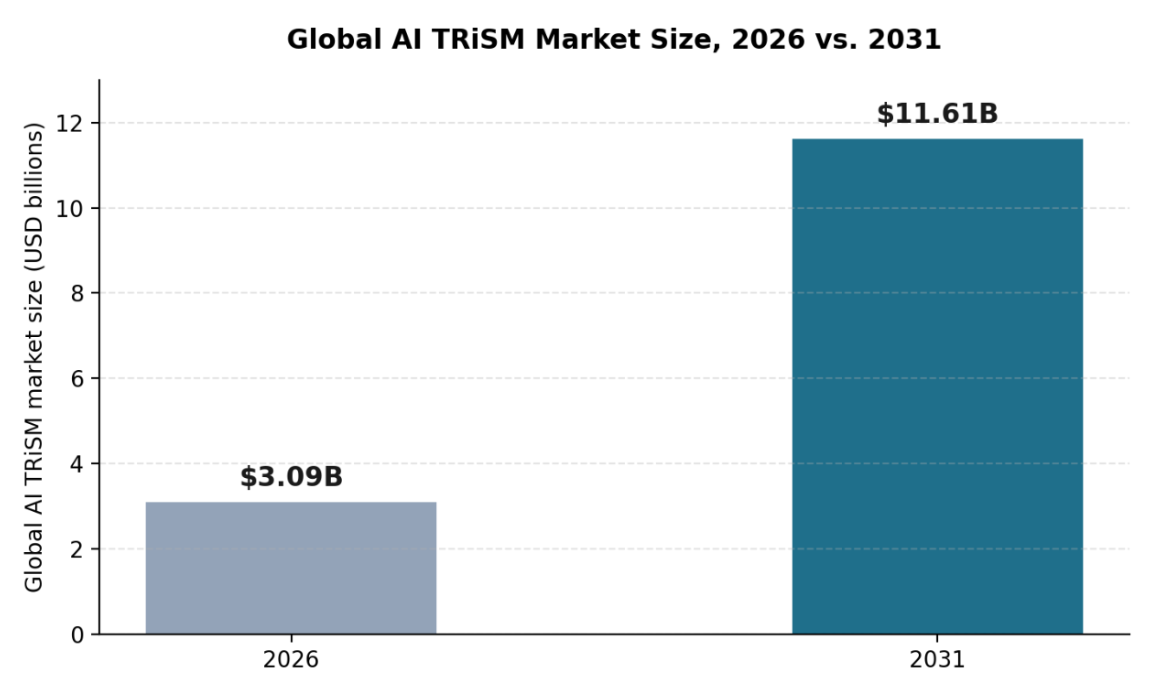

Global AI TRiSM market size, 2026 versus 2031, according to MarketsandMarkets.
What does an AI security platform actually need to cover?
| Pillar | What it covers |
|---|---|
| Discovery (AI-SPM) | A continuous, complete inventory of every AI application, agent, and tool operating across the organization. |
| Runtime protection (guardrails) | Input and output filtering that catches prompt injection, data leakage, and policy violations as interactions happen. |
| Agentic AI security | Visibility into agent decisions, tool calls, and data access, with enforcement that keeps autonomous behavior within intended scope. |
| Compliance & governance | Policy definition and audit-ready documentation mapped to regulations like the EU AI Act, GDPR, and industry-specific standards. |
The case for covering all four pillars from a single AI security platform, rather than four separate point tools, is largely operational: security teams need discovery findings to feed directly into policy enforcement, and agent behavior data to feed directly into compliance reporting, connections that are much harder to maintain across disconnected tools than within one shared system.
Why does agentic AI security specifically need its own attention?
A static chatbot answers questions; an autonomous agent takes actions, and that distinction changes the security calculus considerably. Ovalix’s autonomous and agentic AI security platform is built to give full visibility of AI agent tasks from start to finish, mapping out each decision so guardrails can be enforced and compliance maintained across AI-driven processes, rather than only reviewing outcomes after an agent has already acted. A closely related capability focused specifically on agent behavior safeguards AI agents from malicious manipulation, unauthorized control, and excessive autonomy, which matters because an agent with too much unchecked scope is a fundamentally different risk than a chatbot that simply gives a wrong answer.
What does ‘AI security software’ actually mean in practice?
In practice, the term increasingly refers to platforms consolidating what used to be handled by separate tools, or not handled at all, into one system: shadow AI discovery, data protection, runtime guardrails, and agentic oversight, unified under a shared policy engine and a single source of truth for what AI is running and what it’s doing. That consolidation trend mirrors what happened in adjacent security categories before it, where point solutions eventually gave way to platforms once the operational cost of stitching together separate tools outweighed the benefit of best-of-breed components for each narrow function.
Questions to ask when evaluating an AI security platform
- Does discovery run continuously, or only as a periodic scan that goes stale between runs?
- Does the platform cover agents as well as applications, including tool calls and autonomous decision chains, not just chatbot-style interactions?
- Are guardrails applied in both directions, filtering prompts going in and responses coming out?
- Does compliance reporting draw from the same data as enforcement, or does it require separately maintained records that can drift out of sync?
Frequently Asked Questions
Is AI TRiSM a specific product, or a framework?
AI TRiSM is a framework defined by Gartner, describing a set of capabilities organizations need, not a single named product. Different vendors, including AI security platforms, implement AI TRiSM’s principles in different ways.
Do small organizations need a full AI security platform, or just point tools?
It depends on the scale and complexity of AI usage, but even smaller organizations benefit from discovery and runtime protection working together, since the two feed each other: what you discover shapes what you need to enforce, and vice versa.
What’s the difference between AI security software and general cybersecurity software?
AI security software is purpose-built for risks specific to AI systems, prompt injection, model behavior monitoring, AI agent oversight, that general cybersecurity tools, built around network traffic and endpoint behavior, typically aren’t designed to catch.
Why is agentic AI considered higher risk than earlier generative AI tools?
Because agents don’t just generate text, they take actions and call tools, often chaining multiple steps together autonomously. That expands the potential consequences of a security gap well beyond what a single bad response from a chatbot could cause.