Cybersecurity
AI Security and Governance Framework: The Four Practices Behind an Enforceable Program

| Key Takeaways
• An AI security and governance framework connects policy decisions to operational controls through four practices: discover, detect, govern, and prevent. • NIST AI RMF 1.0 is voluntary guidance released in January 2023 and organized around four functions: Govern, Map, Measure, and Manage. • IBM’s 2026 report found that 68 percent of breached organizations lacked policies to oversee AI use or manage shadow AI. • A framework needs review responsibilities, incident response procedures, and evidence, because policies alone do not show whether controls work. |
What is an AI security and governance framework?
An AI security and governance framework is a structured way to secure and manage AI across an enterprise by connecting policy decisions to operational controls. It rests on four practices: discover which AI is in use, detect risks and policy violations, govern AI activity, and prevent threats before they cause damage. A short definition of an AI security and governance framework describes how these practices reinforce one another without following a fixed sequence.
The distinction between security and governance is practical. Governance defines ownership, acceptable use, and access requirements. Security enforcement applies controls to AI interactions and actions so that activity stays within those requirements. A program with only governance has rules nobody can verify. A program with only enforcement has controls with no mandate behind them.
Which external frameworks should inform an AI program?
Most programs draw on several references at once, because no single one covers governance, management systems, technical risk, and regulation together. The NIST AI Risk Management Framework addresses governance and risk management, ISO/IEC 42001 covers AI management systems, OWASP publishes technical risk lists, and Gartner’s AI TRiSM adds a view of trust, risk, and security management. How the NIST AI RMF is defined in AI security is a good entry point for teams new to the terminology.
| Reference | What it covers | Useful for |
| NIST AI RMF 1.0 | Voluntary framework with four functions: Govern, Map, Measure, Manage | Risk governance and shared vocabulary |
| ISO/IEC 42001 | AI management system standard published in December 2023 | Formal, certifiable management processes |
| OWASP Top 10 lists | Technical risks for LLM applications and, separately, agentic applications | Threat modeling and testing |
| Gartner AI TRiSM | Trust, risk, and security management for AI | Program structure and planning |
| EU AI Act | Regulatory requirements that apply to certain AI uses | Compliance scoping |
The NIST framework is the most widely referenced starting point. NIST released AI RMF 1.0 on January 26, 2023 as voluntary guidance, and its Core is built around four functions: Govern, Map, Measure, and Manage. Govern is cross-cutting and applies to every stage of risk management, while the other three apply to specific systems and lifecycle stages. NIST also published a Generative AI Profile in July 2024 and has said a revised version of the framework is in progress, as its AI Resource Center notes.
ISO/IEC 42001, published in December 2023, takes a different angle by describing an AI management system that organizations can build processes around and certify. Teams frequently use the NIST framework to shape the operational risk practice and a management-system standard to formalize it, while the OWASP lists feed technical testing. Regulatory requirements, including applicable provisions of the EU AI Act, then determine which AI uses need the most documentation and oversight.
Why is a written policy not enough?
A written policy is not enough because policies do not show whether controls work. A framework also needs review responsibilities, incident response procedures, and evidence that lets teams assess whether controls are effective. Without those operational pieces, governance stays a document that nobody can test, audit, or improve over time.
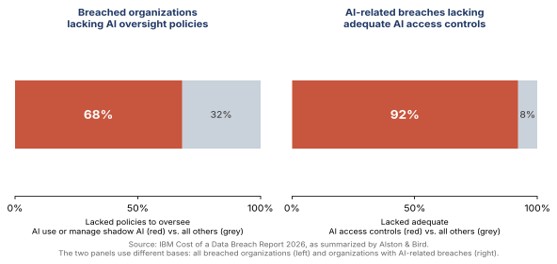
Breach data supports the point. IBM’s 2026 Cost of a Data Breach Report found that 68 percent of breached organizations lacked policies to oversee AI use or manage shadow AI, and that 92 percent of organizations with AI-related breaches lacked adequate AI access controls, according to an Alston & Bird summary. Coverage of the study also reported that fewer than one in five organizations coordinate their governance teams with their security teams.

How do the four practices work in an enterprise?
Each practice answers a different question, and each depends on the one before it. Organizations cannot govern AI they cannot see, and they cannot prevent threats they are not detecting.
- Discover: which AI applications, agents, coding tools, and integrations are in use, and who owns them.
- Detect: where sensitive data exposure, suspicious activity, or policy violations are occurring.
- Govern: what is acceptable, who is accountable, and what access each tool and user is allowed.
- Prevent: how controls such as redaction or blocking apply before a risky interaction or action completes.
Platforms organize these steps differently. Ovalix, for example, applies its Discover, Detect, Govern, and Prevent capabilities across public GenAI applications, homegrown AI, agents, and endpoints, so that visibility and risk detection connect to real-time policy enforcement. Whatever the tooling, the test is whether each policy can be traced to a control and each control to evidence.
What do autonomous agents change for governance?
Autonomous agents change governance by moving the question from what a model says to what it does. Once an agent can call tools and act across business systems, policy has to cover permissions and actions, not only content. This is why OWASP separates its LLM list from a distinct agentic list, and why frameworks increasingly stress human approval for high-impact actions.
Controls for this layer include scoped tool permissions, logging of agent decisions, and approval steps for consequential actions. A closer look at autonomous business systems and their controls covers the components and risks that these controls are meant to address.
How can teams measure whether the framework is working?
Teams can measure effectiveness by checking coverage, enforcement, and response. Coverage asks what share of AI usage is inventoried. Enforcement asks how many policy violations were blocked or redacted before data left. Response asks how quickly an AI-related incident can be investigated with the logs on hand.
Evidence matters because regulators and auditors ask for it. A framework that cannot produce records of who used which AI tool, with what data, under what policy, will struggle in an audit even if its policies read well. The security benefit is similar: IBM found that organizations extensively using AI and automation in security operations cut average breach costs by about $1.93 million and contained breaches roughly 65 days faster, which gives the framework a measurable payoff beyond compliance.
Frequently Asked Questions
What are the core practices of an AI security and governance framework?
They are discovery of AI usage, detection of risks and violations, governance of ownership and acceptable use, and prevention through enforced controls.
How is AI governance different from AI security enforcement?
Governance defines ownership, acceptable use, and access requirements, while enforcement applies controls to AI interactions and actions to keep activity within those requirements.
Is the NIST AI Risk Management Framework mandatory?
No. NIST AI RMF 1.0, released in January 2023, is voluntary guidance organized around the Govern, Map, Measure, and Manage functions.
Why do AI governance policies fail without technical controls?
Policies alone do not show whether controls work, and IBM’s 2026 report found that 92 percent of organizations with AI-related breaches lacked adequate AI access controls.