Cybersecurity
AI Agents Are Multiplying in Your Enterpris-Is Your Security Keeping Up?

Summary: AI agents-autonomous software entities that connect users, systems, and corporate data to perform complex tasks-are being deployed across enterprise environments faster than security teams can track them. Built increasingly by non-technical business users on platforms like Microsoft Copilot Studio and Salesforce Agentforce, these agents introduce a new class of security challenges. This article examines the agentic AI threat landscape, how the market is evolving, and why adaptive, purpose-built security platforms represent the only viable path forward.

The Age of the Agentic Enterprise
Something fundamental is changing in how enterprises operate. Across virtually every industry, organizations are deploying AI agents-software entities capable of reasoning, planning, and executing multi-step tasks autonomously-to automate everything from customer service interactions to complex financial analysis workflows.
These are not simple chatbots or rule-based automations. Modern AI agents can access databases, call external APIs, interpret unstructured documents, generate and send communications, and trigger downstream business processes-all without human intervention at each step. Platforms like Microsoft Copilot Studio, Salesforce Agentforce, and ServiceNow’s AI capabilities have put agent-building tools directly in the hands of business users.
The scale of adoption is striking. According to data cited by Nokod Security, enterprises are now seeing more than 50 new AI agents added to their environments every single day. Multiply that across a quarter or a year, and the numbers become staggering: thousands of autonomous agents operating inside enterprise networks, many with access to sensitive data, connected systems, and critical workflows-and most with no formal security review.
Why Agentic AI Creates Unique Security Challenges
AI agents are fundamentally different from traditional enterprise software -and those differences create security challenges that conventional tools are ill-equipped to handle.
Traditional application security operates on a relatively simple model: analyze static code for known vulnerability patterns, test at fixed points in the development lifecycle, and monitor production systems with predefined rules. This model breaks down almost immediately when applied to AI agents, for several reasons:
• Dynamic behavior: AI agents do not follow fixed execution paths. Their behavior depends on context, user inputs, model outputs, and real-time data-making static analysis largely ineffective.
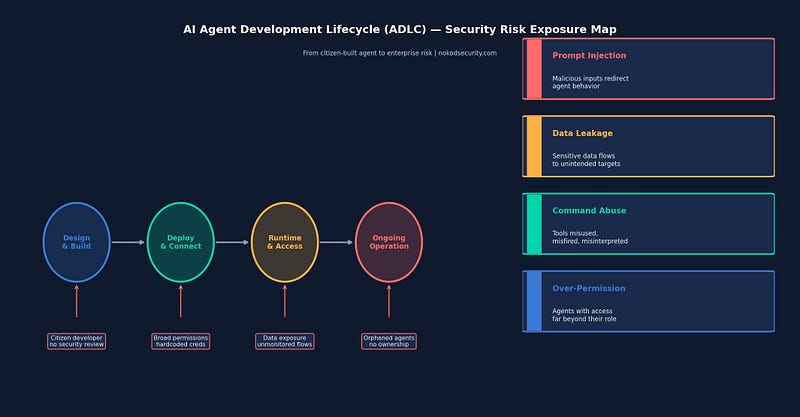
• Citizen-built complexity: Most enterprise AI agents are built not by professional developers, but by business users who lack security training. The Agent Development Lifecycle (ADLC) is compressed, informal, and largely invisible to security teams.
• Broad data access: Agents are designed to be useful, which means they are given access to whatever data they need. Without careful governance, this quickly results in over-permissioned agents with access to data far beyond what their function requires.
• External connectivity: Agents routinely communicate with external APIs, webhooks, and cloud services. Each external connection is a potential exfiltration vector or injection point.
• Prompt injection vulnerabilities: Unlike traditional software, AI agents can be manipulated through their inputs-malicious instructions embedded in documents, emails, or user queries can redirect agent behavior in unpredictable ways.
• Orphaned agents: When the business user who built an agent moves on, the agent keeps running-often indefinitely-under permissions that were never designed to be permanent.
The Emerging Threat: Shadow AI
The phenomenon of shadow AI-AI agents and models deployed outside the formal purview of IT and security governance-is rapidly becoming one of the most significant enterprise security challenges of 2026. It combines the longstanding risks of shadow IT with the unique unpredictability of AI systems.
Security teams are generally aware of the problem in the abstract, but quantifying it is difficult. You cannot protect or govern what you cannot see, and the current state of most enterprise AI inventories is one of near-total opacity. Agents are built across multiple platforms, owned by different business units, and rarely documented in any systematic way.
For comprehensive research on AI governance best practices and frameworks, the National Institute of Standards and Technology (NIST) AI Risk Management Framework offers authoritative guidance for enterprises navigating this landscape.
How the Market Is Responding to Agentic AI Risk
The security industry is in the early stages of developing dedicated solutions for agentic AI risk. Several approaches have emerged:
AI Trust, Risk and Security Management (AI TRiSM) frameworks, as defined by Gartner, provide a conceptual model for governing AI across the enterprise. These frameworks address model explainability, data privacy, and operational resilience-but implementing them requires tooling that most organizations do not yet have.
Some SIEM and SOAR vendors are adding AI-specific detection rules and anomaly models. Cloud security posture management (CSPM) tools are being extended to cover AI services deployed in cloud environments. But these approaches are largely reactive and platform-specific, and they do not address the fundamental challenge of governing citizen-built agents across heterogeneous LCNC environments.
Nokod’s Approach: Adaptive Intelligence for a Dynamic Threat
Nokod Security has built its AI governance capabilities specifically around the realities of how enterprises actually deploy AI agents today-chaotically, rapidly, and across multiple platforms simultaneously.
At the foundation is comprehensive agent discovery and inventory. Nokod automatically maps every copilot, flow, and AI model across supported environments, including Microsoft Copilot Studio and Salesforce Agentforce. It tracks ownership, access permissions, data connections, and model dependencies-giving security teams the living map of their AI landscape that they currently lack.
Critically, Nokod goes beyond static discovery to offer what it calls Adaptive Agent Security: a real-time protection layer that learns the behavioral baseline of each individual agent, then continuously monitors for deviations. Rather than relying on static rules-which are impractical to define for the thousands of unique agents in a large enterprise-Nokod’s adaptive engine profiles each agent’s normal behavior and triggers alerts when something goes off-script.
The platform protects against the specific threats that AI agents face:
• Prompt injection and manipulation: Blocking malicious instructions before they can alter agent behavior.
• Data leakage: Real-time detection and prevention of sensitive data flowing to unauthorized destinations.
• Command abuse: Identifying when agent tools are being misused, misfired, or misinterpreted.
• Insecure calls and risky webhooks: Continuous scanning for unencrypted communications and unauthorized external triggers.
Governance as a Competitive Advantage
Organizations that invest in enterprise AI governance now are positioning themselves for a significant competitive advantage. The ability to deploy AI agents rapidly and confidently-knowing that security guardrails are in place-is a material differentiator in an environment where many enterprises are still paralyzed by uncertainty about AI risk.
Regulatory requirements are also accelerating. The EU AI Act, SEC cybersecurity disclosure rules, and industry-specific regulations like HIPAA and PCI-DSS all have implications for organizations deploying AI agents in production environments. Demonstrating control and governance over AI systems will increasingly be a compliance requirement, not just a best practice.
Conclusion
The agentic AI era is already here. Enterprises that wait for their existing security tools to catch up with the pace of AI agent deployment are accepting a risk they cannot afford. The combination of dynamic behavior, citizen development, broad data access, and prompt injection vulnerabilities creates a threat profile that demands a fundamentally different security approach.
Platforms that deliver true enterprise ai governance-with adaptive, real-time protection that learns and evolves alongside the agents it governs -represent the only sustainable answer to this challenge. Nokod Security is built by AppSec veterans who understand this problem from the inside out, and its platform reflects that depth of expertise.