Cybersecurity
Adaptive AI Agents Need Adaptive Security: A Technical Guide to Runtime Protection

| Key Takeaways
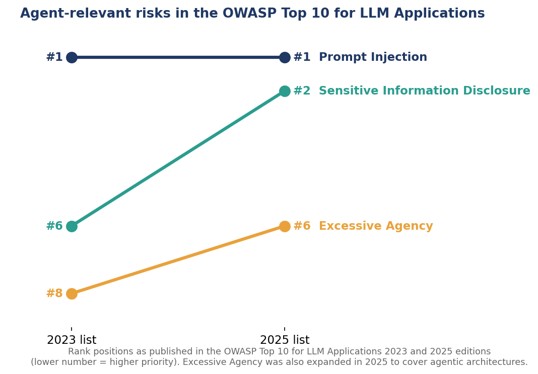
• Adaptive AI agents pursue goals rather than fixed scripts, so their risk appears at runtime rather than in a static configuration file or access list. • An AI agent can expose sensitive data without violating any access control, simply by combining information it is permitted to reach in ways no one anticipated. • In the 2025 OWASP Top 10 for LLM Applications, Sensitive Information Disclosure rose to second place and Excessive Agency was expanded to cover agentic architectures. • Behavioral baselines define risk by deviation from an agent’s normal activity, which lets security intervene precisely without shutting the agent down. |
What makes an AI agent “adaptive”?
An adaptive AI agent is given a goal rather than a fixed script, so it evaluates context, chooses which tools to call and changes its behavior based on live data. That flexibility is what makes adaptive AI agents useful for real business work, and it is also what makes them hard to secure with controls designed for predictable software.
Traditional automation follows defined triggers and produces repeatable outcomes. An adaptive agent built in an enterprise copilot platform, a CRM or an internal-tool builder does not. It may query a different data source tomorrow than it did today, combine information in ways its builder never tested, or respond to an input that was never part of the original design. The security question therefore moves from “what is this agent allowed to do?” to “is what it is doing right now appropriate?”
Why do static, rule-based controls miss agent risk?
Static controls miss agent risk because they assume systems are centrally owned, behave predictably and can be fully assessed before deployment, and adaptive AI agents break all three assumptions. Pre-deployment reviews, access control enumeration, manual approval gates and periodic audits were built for software that changes on a release schedule, not for agents whose behavior shifts with every conversation.
A widely discussed example illustrates the gap between permission and behavior. An internal assistant is built on a business platform and connected through approved connectors. An employee with limited privileges chats with it, and through conversation alone the agent retrieves and synthesizes information that employee could not access directly. No access control is violated and no policy is technically broken, yet sensitive data has moved somewhere it should not. The risk did not live in the configuration. It appeared at runtime.
Which OWASP risks matter most for adaptive AI agents?
Three entries in the OWASP Top 10 for LLM Applications matter most for adaptive AI agents: Prompt Injection, Sensitive Information Disclosure and Excessive Agency. In the 2025 edition, Prompt Injection stayed at number one, Sensitive Information Disclosure rose from sixth to second, and Excessive Agency moved from eighth to sixth and was expanded to cover agentic architectures.
OWASP’s definition of Excessive Agency describes it as the vulnerability that enables damaging actions in response to unexpected, ambiguous or manipulated model outputs, whatever caused the model to malfunction. OWASP traces the root cause to one or more of three factors: excessive functionality, excessive permissions and excessive autonomy. The 2025 guidance also acknowledges that no fool-proof prevention for prompt injection is currently known, which is a strong argument for controls that watch what an agent actually does rather than relying only on filtering what goes into it.

How does a behavioral baseline work for an AI agent?
A behavioral baseline is a profile of an agent’s normal activity, built by observing what data it typically accesses, which tools it calls, who interacts with it and how often it runs. Once the baseline exists, security defines risk by deviation rather than entitlement: an action is suspicious because it is abnormal for that specific agent, not because it is outside a list someone wrote in advance.
This approach usually runs as a four-stage loop. The system first learns each agent’s behavior and context. It then enforces existing security policies as living rules that apply automatically. Third, it detects anomalies against each agent’s own profile, which is more precise than a single threshold applied to every agent. Finally, it prevents risky or noncompliant agents from acting or activating. Importantly, the adaptive layer extends predefined rules rather than replacing them, so existing policies stay in force while coverage expands to edge cases nobody anticipated.
What does runtime enforcement look like without breaking the agent?
Runtime enforcement uses narrow, targeted interventions, such as pausing a single high-risk query, requiring step-up validation for an unexpected action or blocking anomalous outbound traffic, while the agent’s legitimate functions keep running. The goal is to stop the specific harmful action, not to switch the agent off.
In practice, adaptive runtime protection for AI agents focuses on three threat categories. Prompt injection and manipulation covers instructions smuggled in through user input, documents or connected data. Data leakage covers sensitive information flowing to a destination it should not reach. Command abuse covers tools being misused, misfired or misinterpreted by the agent. Each intervention should also alert the agent’s owner with enough context to fix the underlying issue, so the same anomaly does not repeat the next day.
Static rules vs adaptive guardrails: how do they compare?
Static rules are precise for known risks, while adaptive guardrails cover the unknown behavior that emerges once agents meet real users and data, so mature programs use both. The comparison below summarizes how each approach handles the same problems.
| Question | Static, rule-based controls | Adaptive guardrails |
| When is risk assessed? | Before deployment and at periodic audits | Continuously, while the agent runs |
| What defines a violation? | An action outside predefined permissions | An action that deviates from the agent’s normal behavior |
| Coverage of new behavior | Only what rule authors anticipated | Extends to edge cases and novel patterns |
| Typical response | Block, or allow and log | Pause, require step-up validation, block, or alert the owner |
| Effort as agents multiply | Grows with every new agent and rule | Profiles are learned per agent automatically |
Where does adaptive protection fit in the agent development lifecycle?
Adaptive protection covers the runtime stage of the agent development lifecycle, the last of four stages that run from design and build through deployment and runtime. Each stage needs its own controls, in the same way any enterprise application does.
Design and build are where builders choose data sources, tools and permissions, and where least privilege does the most good. Deployment is where approval gates and configuration checks belong. Runtime is where adaptive AI agents reveal behavior that no earlier stage could predict. A whitepaper on runtime controls for enterprise agents frames this as a shift from asking whether a system has access to asking whether an action is appropriate in its current context, and lays out a four-step path for getting there.
For security teams, the practical takeaway is to stop treating approval as the finish line. Agents built by business users will keep evolving after they are approved, and the controls protecting them need to evolve at the same speed.
Frequently Asked Questions
What is an adaptive AI agent?
An adaptive AI agent is an AI system given a goal instead of a fixed script, which evaluates context and chooses its own actions and tools based on live data.
Why are traditional security controls not enough for AI agents?
Traditional controls assess risk before deployment and assume predictable behavior, while AI agents change how they act at runtime, so an agent can stay within its granted permissions and still expose sensitive data.
What is Excessive Agency in AI security?
Excessive Agency is an OWASP Top 10 for LLM Applications risk in which an AI system can take damaging actions because it has excessive functionality, excessive permissions or excessive autonomy.
Do adaptive guardrails replace rule-based security policies?
No, adaptive guardrails extend rule-based policies by learning each agent’s normal behavior and flagging deviations, while predefined rules continue to enforce known requirements.