Tech
7 Signs Your AI Guardrails Won’t Survive Contact With Agentic Systems

Two years ago, a guardrail conversation was mostly about content filtering: stop the chatbot from saying something toxic. The model produced text, the text was safe or it was not, and a classifier could usually tell. In 2026 the problem changed shape, because the model is no longer just producing text. It is calling APIs, querying databases, writing files, sending emails, and triggering workflows. A guardrail failure two years ago meant a bad response. A guardrail failure today can mean a bad action: data deleted, funds transferred, privileged information forwarded to the wrong recipient. Here are seven signs an enterprise’s guardrail approach has not caught up to that shift.
- Guardrails only inspect the chat interface
If the only place content is being checked is the conversational turn between user and model, agentic workflows are moving around that checkpoint entirely. Tool calls, intermediate outputs passed between chained steps, and data pulled from connected systems all need coverage, not just the visible chat window.
- There is no human checkpoint on irreversible actions
Database deletions, external data transfers, financial transactions, and bulk record modifications are operations where a mistaken or manipulated instruction can cause damage that is difficult or impossible to reverse. Enterprises that have not annotated their AI tools by risk level, and built approval flows for anything tagged destructive, are relying entirely on the model getting it right every time.
- The guardrail is a prompted general purpose model
Prompting a general purpose model to act as its own safety classifier is the fastest way to prototype a guardrail, and it is also the slowest one to run in production. The chart below shows why that tradeoff matters once guardrails sit inside an agent’s decision loop rather than at the end of a conversation.
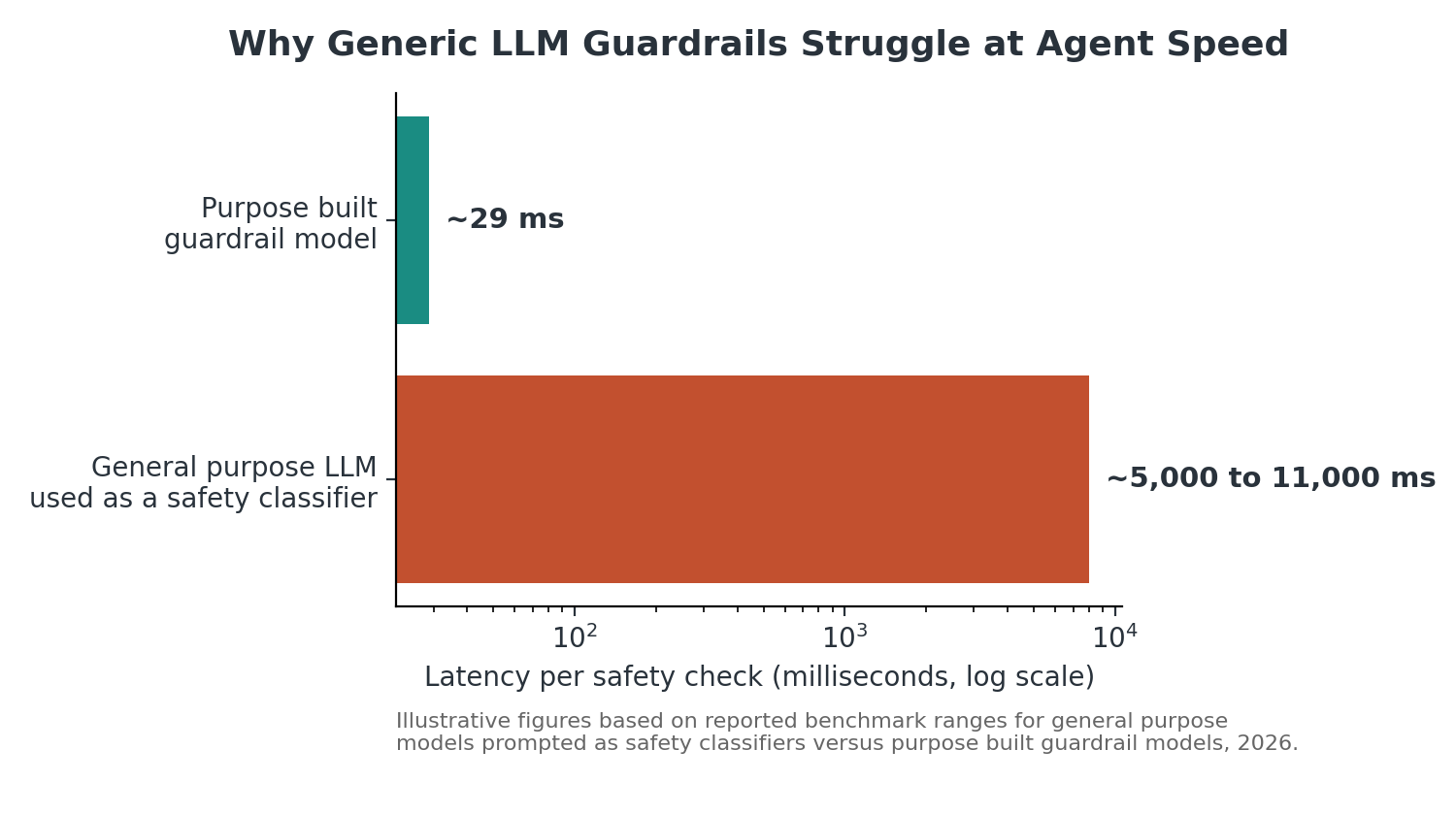

Illustrative figures based on reported benchmark ranges for general purpose models prompted as classifiers versus purpose built guardrail models, 2026.
- Policies are generic instead of specific to the workflow
Out of the box guardrails ship with a fixed taxonomy covering hate speech, violence, sexual content, and basic PII. That is fine for a generic chatbot. It is not fine for a workflow that needs to enforce specific regulatory language, recognize an organization’s own confidential project names, or apply industry-specific rules no generic model has ever seen. Generic guardrails catch generic problems and miss the ones that actually matter to a given business.
- There is no governance layer over employee AI usage
Guardrails on a single deployed application do nothing for the AI tools employees adopt on their own. Consistent governance over employee AI tool usage across sanctioned and unsanctioned tools alike is what turns a guardrail policy from something that applies to one system into something that actually reflects how AI is used across the organization.
- Nobody has adversarially tested the guardrail itself
A guardrail that has only been validated against the cases it was designed to catch will fail the first time it meets an adversarial input it was not trained on. Open source community-standard guard models, for example, see measurable accuracy drops under adversarial pressure and on long context traces compared to their baseline performance. Red teaming the guardrail, not just the underlying model, is what closes that gap before an attacker finds it.
- Governance is only 25 percent implemented, if that
According to a 2025 industry survey, only about 25 percent of companies report a fully implemented AI governance program, even as 88 percent of organizations say they use AI in at least one business function. That gap between usage and governance is exactly where the enterprise AI security risks CISOs are already tracking tend to surface first, since guardrails without an underlying governance program are enforcing rules nobody has actually agreed on organization-wide.
What closing these gaps actually requires
The pattern across all seven signs is the same: guardrails designed for a single conversational turn do not generalize to a system that acts. Closing the gap means covering tool calls and not just chat, gating irreversible actions behind human review, using purpose-built models fast enough to run inline, tailoring policy to the specific workflow, extending governance to tools employees adopted informally, adversarially testing the guardrail itself, and treating all of it as a program rather than a one-time deployment. A recent look at how enterprises are approaching the related discipline of preventing AI data leakage is worth reading alongside guardrail planning, since the two controls typically need to work together
Frequently Asked Questions
Are guardrails the same thing as AI governance?
No. Guardrails are the runtime controls that catch or block specific behaviors. Governance is the broader program, ownership, policy, and accountability structure that decides what those controls should actually enforce.
Why do agentic systems need different guardrails than chatbots?
Chatbots produce text a human reads before acting on it. Agents can take the action directly, so a guardrail failure has a much larger and sometimes irreversible blast radius, which changes both what needs to be checked and how fast the check needs to run.
What is the fastest way to test whether current guardrails are sufficient?
Red team them the same way the underlying model would be tested, using adversarial examples specific to the organization’s actual policies and workflows rather than relying only on the vendor’s published benchmark results.