Tech
5G in Defense: How Military Connectivity Is Changing and Why It Matters


| Key Takeaways
• The global 5G-in-defense market was valued at roughly $1.36 billion in 2025 and is projected to reach about $6.86 billion by 2034, a 19.46% compound annual growth rate. • More than 25 military installations across the U.S., Europe and Asia-Pacific are already testing 5G tactical networks, mostly using private, standalone deployments rather than public carrier infrastructure. • NATO expects 5G’s low latency and machine-interface capacity to improve command and control, sustainment, and force projection, and has already tested it for augmented reality and deployable headquarters scenarios. • Edge computing is commonly paired with 5G in defense networks so platforms can keep processing video and sensor data locally even when connectivity is degraded. |
How is 5G actually used in military and defense operations?
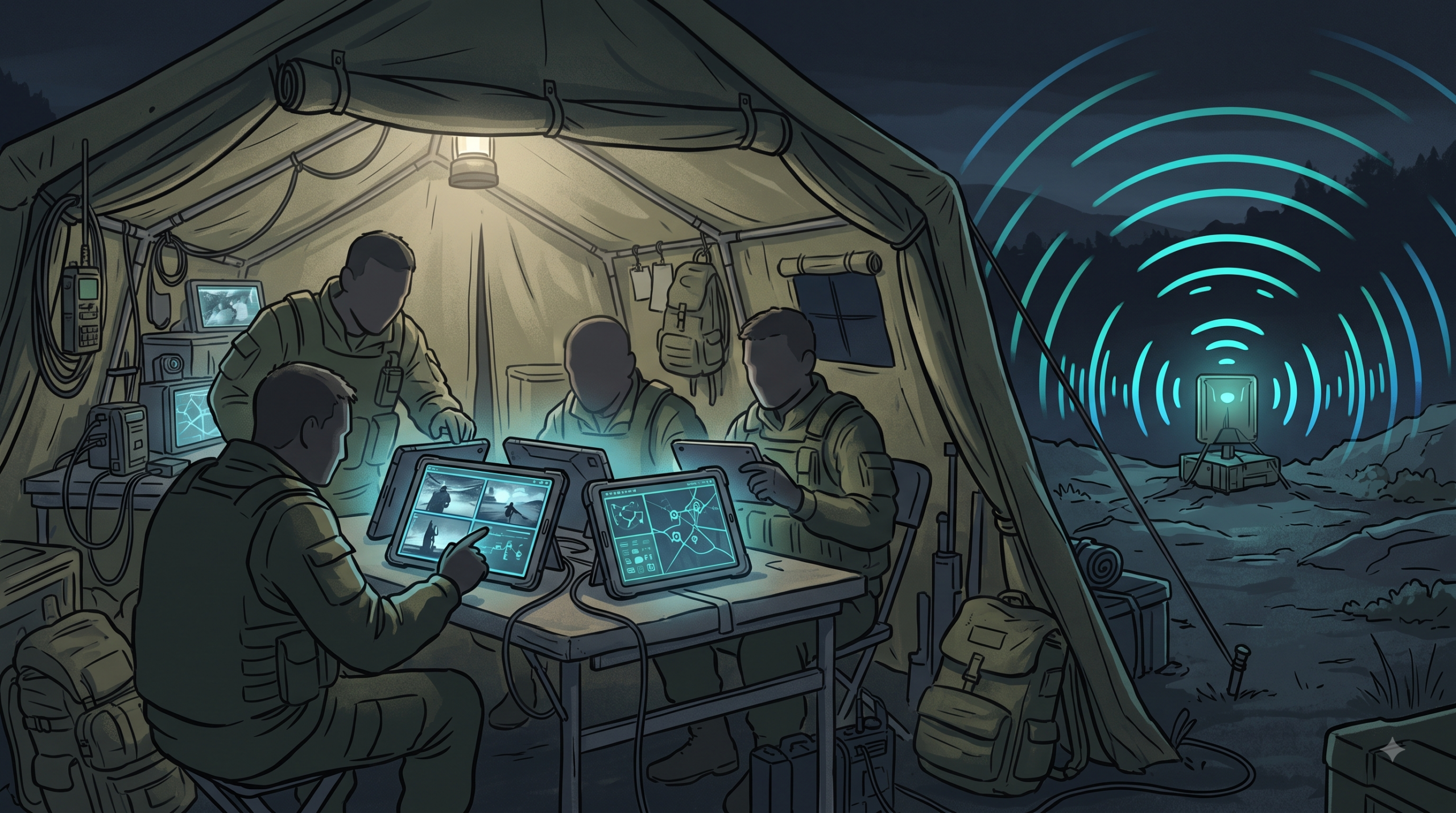
5G is used in defense to give command posts, sensors, and unmanned systems a shared, low-latency wireless network that can carry far more data than legacy tactical radio, including live video, sensor feeds, and geolocation data moving at once. Reported use cases span command, control, communications, computers, intelligence, surveillance and reconnaissance (C4ISR), autonomous ground and aerial robotics, smart base infrastructure, and remote control of weapons and sensors. What makes 5G different from earlier tactical data links is less the top-line speed and more its ability to carry many of these data streams, video, telemetry, sensor readings, at once, on a shared network, instead of requiring a separate dedicated link for each system. That consolidation also simplifies logistics in the field: fewer separate radio systems to carry, power and maintain means fewer points of failure for a unit operating away from a fixed base. an overview of how 5G is reshaping military connectivity covers the connectivity side of that shift in more depth.
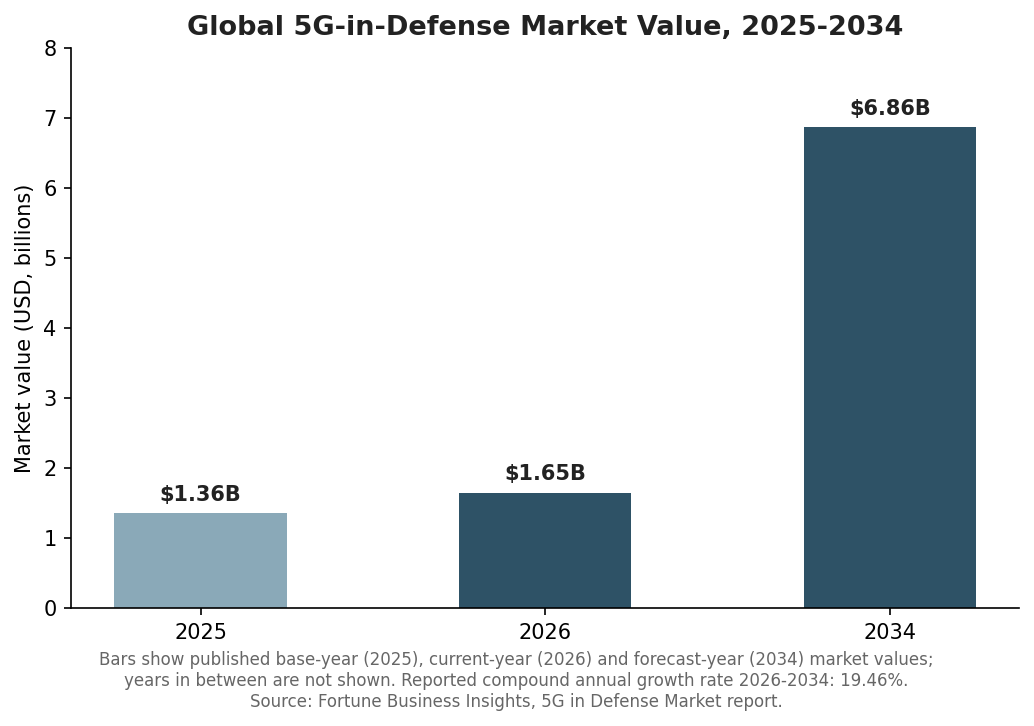

Global 5G-in-defense market value, 2025-2034 (published base, current and forecast years). Source: Fortune Business Insights.
How big is the 5G-in-defense market, and how fast is it growing?
The global 5G-in-defense market was valued at roughly $1.36 billion in 2025 and is projected to reach about $6.86 billion by 2034, a compound annual growth rate of 19.46% between 2026 and 2034. North America currently holds the largest regional share at 43%, while Asia-Pacific is the fastest-growing region at a 24.8% CAGR. Market analysts tie the growth directly to autonomous-systems adoption and geopolitical pressure: the Russia-Ukraine conflict is cited as accelerating adoption by demonstrating how “connectivity, data advantage, and autonomous systems” shape modern warfare outcomes. That framing lines up with how defense budgets typically move: a conflict that visibly rewards a specific capability tends to pull procurement forward across allied militaries watching the same conflict, not just the country directly involved. market research tracking the 5G-in-defense sector’s growth breaks the regional and segment figures down further.
Why does low latency matter more for defense networks than for consumer 5G?
Low latency matters more for defense than for consumer 5G because the systems on the other end are often making or informing real-time decisions, from remote-controlling an unmanned vehicle to fusing radar and video feeds for a commander in the field. NATO frames the strategic case in similar terms, expecting 5G’s “massive machine interface, ultra-reliability, and low-latency characteristics” to help forces stay “aware, agile, networked, and lethal” and to “enhance sustainment, command and control, projection of forces, [and] increase responsiveness to inform decision makers.” The alliance has already run 5G testbeds for augmented and virtual reality communications and deployable headquarters scenarios at forward-presence bases under its Cross Domain Command initiative. why real-time decisions are moving from the cloud to the edge looks at the same latency pressure from the processing side, not just the network side.
What specific use cases are militaries piloting on 5G testbeds today?
Rather than deploying 5G everywhere at once, most defense organizations are running narrow, scenario-specific pilots first, so problems surface in a testbed rather than in an operational network. NATO’s own experimentation timeline illustrates that staged approach: augmented and virtual reality applications for satellite communications and deployable communications systems were tested in 2022, followed by deployed headquarters and medical-scenario use cases in 2023, all run under the alliance’s “Experiment in Operations” category at forward-presence bases. That sequencing, communications first, then command applications, then more specialized scenarios like medical evacuation coordination, reflects how new network technology typically earns its way into wider military use: prove it on the lowest-risk use case, then expand. The initiative sits inside NATO’s broader Cross Domain Command Warfare Development Imperative, which is focused specifically on network infrastructure innovation rather than any single weapons platform, underscoring that the alliance sees connectivity itself, not just any one system riding on it, as the capability worth investing in.
How many military sites are already testing 5G tactical networks?
Industry reporting counts more than 25 military installations across the U.S., Europe, and Asia-Pacific already testing 5G tactical networks, and one market estimate projects that 45% of global defense communication infrastructure will incorporate 5G technology by 2030. Those tests lean heavily on private, standalone 5G networks rather than public carrier infrastructure, since a private network can be deployed on demand in the field and kept isolated from outside traffic for security. A private deployment also sidesteps a problem public networks cannot solve for defense users: a base or a moving convoy needs coverage in places no commercial carrier has any incentive to build permanent towers, so the network has to travel with the unit instead. situational-awareness platforms used across defense operations gives a sense of what actually has to move across those networks: live video and sensor data from multiple platforms at once.
What role does edge computing play alongside 5G in defense networks?
Edge computing complements 5G by processing video and sensor data on or near the device that captured it, rather than sending every frame back over the network first, which reduces both the bandwidth a 5G link has to carry and the delay before a decision-ready output is available. This pairing matters most in disconnected or degraded environments, where even a fast network link can be interrupted, so an edge system that can still analyze its own feed locally keeps a platform useful without a live connection. It also changes what the 5G link is actually used for: instead of streaming raw, uncompressed sensor output back to a command post and asking a human or a remote system to make sense of it, the network mainly carries an already-processed result, which is a far smaller and more resilient data flow to keep alive under contested conditions. For a network planner, that distinction is what determines whether a 5G rollout actually delivers the promised responsiveness in the field or simply moves the same bandwidth bottleneck one layer deeper into the system. what edge computing means for real-time defense networks and military surveillance systems built for edge deployment both cover pieces of that same on-platform processing approach.
Frequently Asked Questions
What does 5G add to military communications that 4G or tactical radio cannot?
5G adds substantially higher data throughput and lower latency than legacy tactical radio or 4G, which lets a network carry live video, sensor data and geolocation information from many platforms simultaneously rather than one narrow data stream at a time.
How large is the global 5G-in-defense market?
The global 5G-in-defense market was valued at approximately $1.36 billion in 2025 and is forecast to grow to about $6.86 billion by 2034, a compound annual growth rate of roughly 19.46%.
Do militaries use public 5G networks or private ones?
Militaries testing 5G tactical networks predominantly use private, standalone 5G networks that can be deployed on demand in the field and isolated from public carrier traffic for security.
Why is edge computing paired with 5G in defense systems?
Edge computing processes video and sensor data locally on the platform that captured it, which reduces the load a 5G network has to carry and keeps systems functional even when connectivity is degraded or temporarily lost.